

One of the first big MCAT decisions a student faces isn’t what to study, but how to study. Self-study? A self-paced MCAT course? An instructor-led MCAT course? Private MCAT tutoring? Figuring out which MCAT prep is most effective is almost as overwhelming as the test itself.
Everyone wants the same thing: the biggest score jump in the least amount of time, without burning out before test day. However, there is no universally “best” MCAT prep option that will fit every single student. Effectiveness depends on who you are as a student, where you’re starting, and what you need most.
Let’s break this down using what actually matters: score improvement, time efficiency, retention, test-day performance, and burnout risk.
Finding the Most Effective MCAT Prep
Self-Study: High Ceiling, High Risk
✅ Who it works best for:
- Strong test-takers with solid science foundations
- Highly disciplined, self-directed students
- Students starting at or near their goal score
- People with flexible timelines and strong planning skills
Self-study is the most customizable and often the cheapest option. When done well, it can be incredibly effective. You control the pace, the resources, and the schedule, which means no wasted time on content you already know.
However, here’s the catch: self-study has the highest risk of failure. Most students don’t struggle because they’re lazy. They struggle because they don’t know what to prioritize, spend too much time on low-yield content, confuse content review with improving performance, and don’t recognize gaps until it is too late in their studying.
Score improvement can be excellent, but only if strategy and review are done correctly. Time efficiency is highly variable, depending on the student and how they go about studying. Retention and performance are similar; it depends entirely on the quality of practice and review. Burnout risk is moderate to high, particularly because of isolation and decision fatigue.
💡Self-study works best when you already know how to study for the MCAT, not when you are trying to figure it out from scratch.
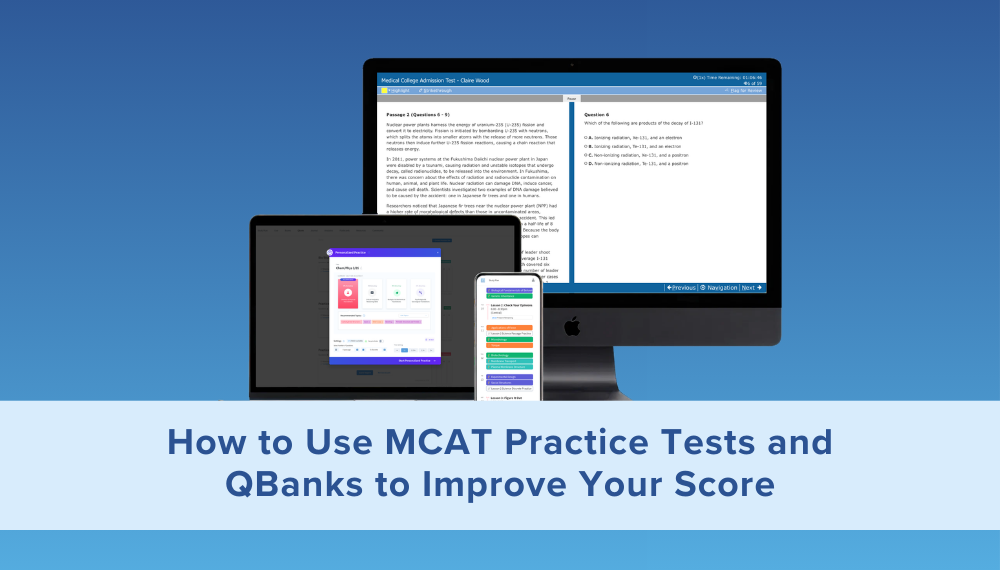
If you’re going the self-study route, one thing isn’t optional: realistic, tailored practice. Blueprint MCAT Practice Tests and Qbank give you the most representative practice available with detailed explanations and performance data that show you exactly where your gaps are before test day.
Self-Paced Courses: Structure Without Accountability
✅ Who it works best for:
- Students who want structure but prefer independence
- Those who need content organization
- Students with moderate discipline who like checklists
Self-paced MCAT courses give you a pre-built curriculum, content videos, and practice tools, which removes the burden of planning. That alone can save a lot of mental energy.
However, structure without accountability may not be enough. Many students fall into the trap of watching videos passively, racing through modules, falling behind and feeling overwhelmed, or avoiding practice before content review is complete.
Score improvement tends to be moderate, as students cover a lot of content with less strategy. Time efficiency is variable. Although there is structure, it depends on students to pace themselves. Retention and test-day performance depend on how actively the student is able to engage. Burnout risk increases as students fall behind on the courses.
💡Self-paced MCAT courses help organize studying, but they don’t correct inefficient habits or flawed test-taking logic.
Blueprint’s Self-Paced MCAT Course gives you the structure of a full curriculum with the flexibility to move on your own terms. With 160+ hours of engaging videos, a built-in study planner, and integrated practice, it’s designed to keep you active and accountable — not just watching and hoping it sticks.
Instructor-Led Courses: The Best Balance for Most Students
✅ Who it works best for:
- Students starting below their goal score
- First-time MCAT takers
- Students who struggle with consistency or confidence
- Anyone who benefits from external accountability
Instructor-led MCAT courses add the missing pieces many students don’t realize they need: real-time explanation, strategy coaching, and accountability.
A good MCAT instructor doesn’t just teach content. They teach:
- How to think through passages
- How to review efficiently
- How to recognize patterns and mistakes
- How to avoid common MCAT traps
Score improvement is consistently strong, and time efficiency is high due to less wasted effort and clear priorities. Retention and test-day performance are strong due to repeated application and reinforcement. Burnout risk tends to be lower due to pacing and external support.
💡Live MCAT classes offer the best balance of accountability and support. However, following a set class schedule might be difficult for some students who require a bit more flexibility.
Blueprint’s MCAT Live Online Course brings expert instruction and built-in accountability together in one place. For students with their sights set on a 515 MCAT score, Blueprint’s 515+ Course is built specifically for high scorers who want to close the final gap.
Tutoring: Precision and Accountability
✅ Who it works best for:
- Students with specific weaknesses
- Retakers who have plateaued
- Students pushing for top scores
- Students with limited time
Tutoring is most effective when it’s targeted, not used as a replacement for independent work. A good MCAT tutor diagnoses issues and helps you fix them quickly.
Score improvement is great when used strategically, and tutoring can be highly time-efficient. Retention and test-day performance depend on the student’s work outside of tutoring hours, but can be great if sessions are paired with consistent practice. Burnout risk is lower with external support and student engagement.
💡 Tutoring can be a great MCAT prep option for students who have already tried studying a different way and still feel stuck, students who want a personal coach, not another classroom, or students who are on a tight timeline and need to make every hour count.
Blueprint’s MCAT tutors are top scorers who have been through exactly what you’re going through. They don’t just know the material—they know exactly what it takes to master it. Whether you’re stuck on a specific section, pushing for a top score, or just need someone to cut through the noise and tell you what to focus on, a Blueprint MCAT tutor turns every session turns every session into real progress.
How to Choose Which MCAT Prep Option Is Right for You
Before deciding which MCAT prep is most effective, ask yourself:
- Do I struggle more with content, strategy, or consistency?
- Have I ever successfully self-studied for a major exam?
- Do I tend to over-study, under-study, or avoid practice?
- Am I starting far from my goal score?
- How much structure do I realistically need?
- What is my budget?
Common Mistakes Students Make
- Choosing the cheapest option instead of the most effective/appropriate
- Prioritizing content completion over practice mastery
- Studying longer instead of smarter
- Waiting too long to ask for help
- Assuming one method works for everyone
Final Thoughts
So, which is the most effective MCAT prep? The most effective MCAT prep style is one that improves your score efficiently, reinforces skills you will use on test day, reduces burnout, and matches your personality. There’s no prize for studying for the MCAT yourself. The goal is a strong score, not proving you can suffer through the process alone.
If you choose wisely, your prep won’t just raise your score. It’ll also make test day feel manageable, predictable, and calm.
Not ready to commit to an MCAT prep option? Start your free Blueprint MCAT trial and get access to two practice tests, our MCAT Qbank, personalized study planner, and more!