


As a med student this late in the game, you’re familiar with stress. You and stress are frenemies, if you will. You know how stress likes its eggs, you know where stress goes when it needs to get away, you know stress’s middle name.
Despite the bond you share, stress is still the worst! No one wants stress at their party. But, according to psychologists, a little stress can actually be quite helpful. If you somehow dodged cramming the Yerkes-Dodson curve into your brain back when you were prepping for the MCAT, allow us to explain!
What is the Yerkes-Dodson Curve?
In 1908, a couple of psychologists (Yerkes and Dodson, of course) discovered that mice performed both simple and difficult tasks better at an optimal level of arousal. This optimal level of arousal sat between low arousal and high arousal (illustrated below). To be accurate, they also found that performance in simple tasks continued to increase with high levels of arousal or stress, but that difficult tasks took a dive in performance as anxiety increased.
The model below is the more popularized Hebbian version of the Yerkes-Dodson curve, which is the one most relevant for our purposes.
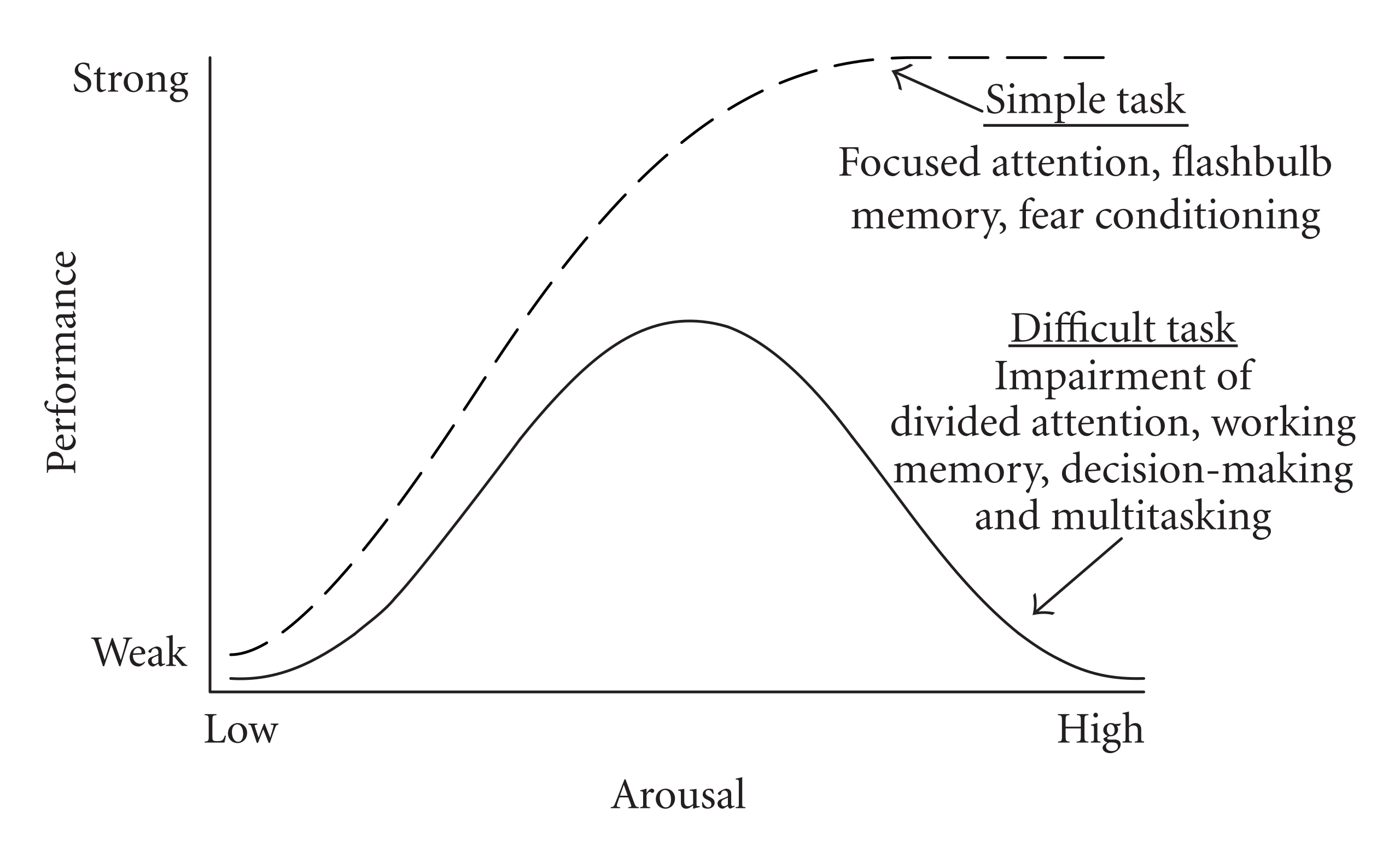
Although the curve is based on older data, modern research shows there’s an inverted, U-shaped relationship between arousal and learning.
Yerkes-Dodson and Your Stress Sweet Spot
As with everything, the optimal level of stress is different for everyone. What may be very little stress for one person may be incredibly challenging for another. You know what this feels like, though, remember? Frenemies?
Having a little fire under your feet can be good. It’s motivating and clears your head. But you also know how it feels to be so stressed it seems like maybe you never actually had access to your own thoughts. Or so bored you can’t remember what you ate for breakfast, let alone recall any complex information.
In other words, you know what amount of stress works for you, and what amount sends you spiraling.
Change Your Mindset.
So, what does this mean for you? It means in order to study effectively you’re going to need to administer the optimal level of electric shocks to your body. Sorry, we don’t make the rules. Kidding!
Actually, it means you can use time and reasonable constraints to your advantage. For example, understanding how arousal levels impact your performance helps you see the timing tools on your Qbank blocks not just as ways to practice for the actual test, but as tools to better your focus and determination.
It also means that building a strict-not-so-strict study schedule (dare we say optimal) is not something you do just for planning purposes. It can also help your performance overall!
And you know who can help you build a study schedule?
Let Blueprint’s Med School Study Planner take away the stress of planning and managing a study plan for USMLE Step 1, Step 2, COMLEX, and your shelf exams—sign up today and create your personalized study plan in minutes!
How to Apply the Yerkes-Dodson Curve
We see this information as a tool for your intuition. Next time you just can’t get your head on straight during your dedicated, take a moment to analyze your stress levels. Are you feeling lifeless? Maybe you need to add an attainable time constraint to the block you’re on, or try to challenge yourself with a new topic.
Other things you can do to stay in the sweet spot of the curve include:
Stay curious.
Curiosity is a great knowledge builder because it keeps you motivated. It supplies a perfect amount of drive to stay in the sweet spot of the arousal curve.
If you’re stuck studying something that isn’t particularly interesting, start with the aspect you find most intriguing and take it from there. Once your curiosity is engaged, the topic can open up to you in a whole new way.
Get a body double.
Body doubling is a technique in which you work with someone else present. The amazing thing is the mere presence of the other person can make you more productive, even if they aren’t doing the same thing you are.
Doubling is a great way to stay in the optimal part of the arousal curve, all while having some company. That’s always good to have during the sometimes lonely season of dedicated.
Use active learning methods.
You can use any number of active learning techniques like self-explanation, elaborative interrogation, elaborative discussion, learning by teaching, dual coding, or interleaving. These learning methods will help you stay engaged and in the sweet spot of the curve.
Get some exercise.
Try to get some exercise on study days. Physical activity will keep you in a state of arousal and attention that’s conducive to learning. Getting moderate exercise during a study break is a great way to stay energized and focused during exam preparation.
Do something different.
If you’re getting bored, it means you’re sliding into the low end of the arousal curve. That means it’s time to mix things up! You can change the topic, the study materials, your study methods, anything you need to do to stay engaged.
Release your inner B.F. Skinner!
Positive reinforcement is good for learning. To stay motivated, give yourself things to look forward to. Schedule breaks to have coffee, a little chocolate, or give your friend a call. Or just relax and feel proud of the progress you’re making.
That said, rewards need to keep you stimulated, happy, and excited to learn. If they make you lethargic or create too much distraction, you’ll no longer be in that wonderful Yekes-Dodson sweet spot. So choose your reinforcements wisely.
So, those are six things you can do if you’re feeling lifeless and not motivated to study. Now let’s take a look at some steps to take if you don’t need to induce stress, but reduce it.
How to Reduce Stress and Stay in the Optimal Part of the Curve
If you’re feeling too stressed, consider taking a walk, or step away to get a few things done that you can’t get off your mind. Some other things you can do to reduce stress when studying include:
Don’t fear confusion.
If you’re stressed out because you’re confused by a particular topic, try to relax. Like curiosity, confusion could also be a sign that a serious dose of discovery is on the way. Whatever the subject is, you’ll get it eventually, even if it takes a while. And that’s fine, because once it all clicks in a beautiful moment of insight, it’s unlikely to be forgotten.
Break overwhelming topics into manageable pieces.
Feeling challenged is great, as it means you’re mentally stimulated and in the right part of the Yerkes-Dodson curve. But if you never want to be overwhelmed. If there’s a topic you just can’t wrap your head around, try breaking it into manageable pieces. Maybe start with the one you’re most curious about. This will help you stay motivated while avoiding as much stress as possible.
What do you do if you’re at the extreme end of the stress/anxiety curve?
If you’re feeling overwhelmed by general anxiety or panic attack symptoms, take a break from studying. As the curve indicates, you’re probably not going to learn anything, and it’s important to remove yourself from the situation so you can get a handle on your anxiety.
Deep breathing (diaphragmatic or belly breathing) exercises are great for reducing anxiety and ending a panic attack. They can also be used to prevent an attack if you feel one coming on.
One deep breathing technique many people find helpful is known as “box breathing.” It can be done anywhere at any time. Simply breathe in through your nose for four seconds, hold your breath for four seconds, breath out for four seconds, and then hold your breath for four seconds. Repeat this cycle until your anxiety subsides.
While box breathing and other deep breathing exercises are great for temporarily reducing anxiety, if anxiety symptoms are interfering with your studying it’s important to consult a mental health professional. The good news is that anxiety is treatable, so they can help you. But it’s important to get your anxiety symptoms under control so you can get back to the Yekes-Dodson sweet spot and maximize your learning!
Conclusion
Stress is a frenemy! The right amount can actually help you prepare for your exams. Be sure to use the Yerkes-Dodson Curve to your advantage as you prepare for USMLE Step 1 and Step 2. Look for signs your arousal level is either too low or too high, and adjust accordingly. Remember, a little stress is a good thing! Good luck preparing for your exams, and be sure to reach out to the tutors at Blueprint if you need further assistance!