


After conquering Step 1, it’s time to strategize for Step 2. This second exam in the USMLE series evaluates your clinical science knowledge and patient care skills, making it a critical step in your medical education journey.
Now that Step 1 is pass/fail, Step 2 strongly affects your residency application and overall competitiveness as an applicant more than ever. And with the May 2026 updates to the Step 2 exam structure—including changes to block length and number of blocks—it’s especially important to understand how the new test-day format works before you begin preparing.
If you’re feeling a bit overwhelmed by this, you’re not alone! We’re going to fill you in on some important details like Step 2 score benchmarks by specialty, the exam’s structure, content, and some frequently asked questions. Let’s dive in!

Preparing for Step 2? Meet the combined Step 2 & Shelf Exams Qbank with 5,500+ practice questions that most closely match what you’ll see on your USMLE Step 2 and all of your shelf exams.
Get started with a 7-day free trial!
Why USMLE Step 2 Matters in 2026
1. It showcases your clinical acumen to residency programs.
Take Step 2 seriously, as programs consider your score an indication of your clinical reasoning skill and readiness for direct patient care.
2. It demonstrates your broad clinical competency.
Step 2 evaluates knowledge across various medical specialties, emphasizing diagnosis, management, and patient outcomes, which are essential for residency training regardless of which specialty you apply to.
3. It can give you a shot at redemption.
For those with blemishes on their residency application, a strong Step 2 score can demonstrate growth and preparedness, which will strengthen your application.
4 FAQs About USMLE Step 2
1. How long do most students study for USMLE Step 2?
According to our statistics, Blueprint learners study an average of 103.5 days for Step 2.
2. What are the most popular months to take Step 2?
The top three months for Blueprint Med School Study Planner users to take Step 2 are July, June, and August. For a complete list of when our customers most often take Step 2, visit our page with the most popular months.
3. What do I need to score on Step 2?
The minimum passing score for USMLE Step 2 is 218. In the United States, 98% of MD students passed Step 2 on the first attempt in the 2024-2025 academic year. The pass rate for DO students was 96% for the same year.
4. What is considered a good score on Step 2?
According to the USMLE, scoring above 250 is above average, though it will highly depend on the specialty you apply for. Scoring above 260 puts you in the top quartile.
💡 For even more information, be sure to check out my other post on Step 2 percentiles!
Score Benchmarks by Specialty
Your Step 2 score is a major factor in how you match. The most competitive specialties, including dermatology, plastic surgery, orthopedics, and interventional radiology, often have applicants with scores well over 250.
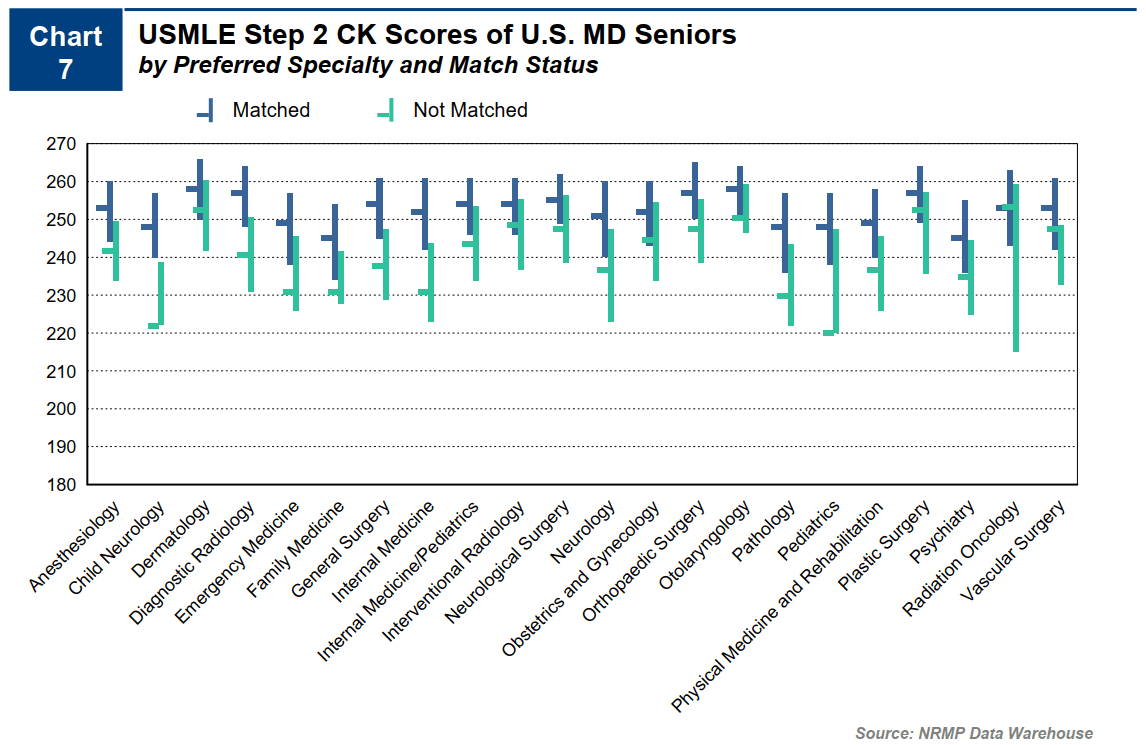
(Source: NRMP 2024 Charting Outcomes)
Use your target specialty’s average as a benchmark and aim to exceed it if possible. As program directors increasingly focus on USMLE Step 2 scores, the exam has become a differentiator. Competitive applicants often use Step 2 scores to highlight their ability to excel in residency training.
Note: Step 2 CS, the clinical skills portion, was discontinued in 2021.
USMLE Step 2 Exam Structure (2026 Update)
Here’s a breakdown of the key details with the 2026 software changes:
USMLE Step 2 is a one-day exam composed of multiple blocks of multiple-choice questions. In May 2026, the USMLE program is rolling out updated test delivery software that changes how the exam is structured in terms of blocks and block length—but does not change the exam content, total number of questions, or overall exam day duration.
What’s changing in 2026?
- The total number of questions and total test day length remain the same.
- However, you’ll now answer the same content in more, shorter blocks. Specifically:
- 16 blocks instead of 8
- 18–20 questions per block instead of up to 40
- 30 minutes per block instead of 60
- The total number of questions and total exam length remain the same!
You’ll see how many questions are in a given block before you start it. As with the previous software, you can only review items within the current block and you are unable to return to previous blocks once closed.
You’ll still have the option to take a 15-minute tutorial with the new interface before test day begins. If you finish early on one or more blocks, your cumulative break time between blocks may exceed 45 minutes, and you can use your break time at your discretion.
So, to summarize:
⏰ Total Testing Time:
9 hours (including instructions and exam breaks)⌛ Time per Block:
30 minutes (previously 60 minutes)☕ Break Time:
45 minutes (which can be extended by finishing blocks early or skipping the tutorial)❓Total Questions:
316🧱 Questions per Block:
18–20 (previously 38-40)🧱 Number of Blocks:
16 (previously 8)
Questions Typically Seen on USMLE Step 2
1. Single-Item Questions
A single patient-centered vignette is associated with one question followed by four or more response options. The response options are lettered (i.e., A, B, C, D, E). A portion of the questions involves interpretation of graphic or pictorial materials.
You’re required to select the best answer to the question. Other options may be partially correct, but there’s only ONE BEST answer. This is the traditional, most frequently used multiple-choice question format on the examination.
2. Sequential-Item Sets
These consist of two or three consecutive questions about the same patient scenario. You can’t return to previous questions after answering the first question in the set, as it may give away the answer to following questions.
A single patient-centered vignette may be associated with two or three consecutive questions about the information presented. Each question is associated with the initial patient vignette but is testing a different point.
You’re required to select the ONE BEST answer to each question. Questions are designed to be answered in sequential order. You must click “Proceed to Next Item” to view the next item in the set. Once you click on this button, the next question will be displayed, and you won’t be able to change the answer to the previous question.
3. Abstract-Set Questions
The abstract-item format includes a summary of an experiment or clinical investigation presented in a manner commonly encountered by a physician, e.g., as an abstract that accompanies a research report in a medical journal.
Examinees must interpret the abstract in order to answer questions on various topics, including:
- Decisions about the care of an individual patient
- Biostatistics/Epidemiology
- Pharmacology/Therapeutics
- The use of diagnostic studies
Step 2 Content Distribution
Below is a content outline of USMLE Step 2 as provided by the USMLE.* Test questions are grouped into 18 categories, focusing either on concepts and principles relevant across organ systems or those specific to individual organ systems.
Each topic is weighted, meaning you can expect a certain percentage of exam questions to be based on it. Be aware that not every topic from the content outline appears on every USMLE Step exam, but the overall content coverage is consistent across the different exam forms taken by examinees.
* Note that these percentages are subject to change at any time.
Content Specifications
| System/Discipline | Range, %* |
|---|---|
| Nutrition | 15–20 |
| Social Sciences: Legal/Ethical Issues & Professionalism/Systems-based Practice & Patient Safety | 10-15 |
| Renal & Urinary System & Reproductive Systems | 7–13 |
| Cardiovascular System | 6–12 |
| Musculoskeletal System/Skin & Subcutaneous Tissue | 6–12 |
| Behavioral Health | 5–10 |
| Blood & Lymphoreticular/Immune Systems | 5-10 |
| Gastrointestinal System | 5–10 |
| Nervous System & Special Senses | 5–10 |
| Respiratory System | 5–10 |
| Multisystem Processes & Disorders | 4–8 |
| Endocrine System | 3–7 |
| Pregnancy, Childbirth & the Puerperium | 3–7 |
| Biostatistics & Epidemiology/Population Health/Interpretation of Medical Literature | 3–5 |
| Human Development** | 2–4 |
** The Human Development topic includes Normal Age-Related Findings and Care of the Well Patient.
Source: USMLE
Physician Tasks/Competencies
| Competency | Range, %* |
|---|---|
| Patient Care: Diagnosis | 16–20 |
| Patient Care: Laboratory/Diagnostic Studies | 13–17 |
| Patient Care: Mixed Management | 12–16 |
| Patient Care: Pharmacotherapy | 8–12 |
| Patient Care: Clinical Interventions | 6–10 |
| Patient Care: Health Maintenance/Disease Prevention | 5–10 |
| Patient Care: Prognosis/Outcome | 5–9 |
| Systems-based Practice & Patient Safety | 5–7 |
| Professionalism | 5–7 |
| Practice-based Learning & Improvement | 3–5 |
| Medical Knowledge: Applying Foundational Science Concepts | 0** |
| Patient Care: History and Physical Exam | 0*** |
** Test items that assess patient care competencies may also assess knowledge of underlying foundational science concepts.
*** Test items that assess history and physical exam competencies are covered in Step 1 and Step 3 examinations.
Source: USMLE
Clinical Science Specifications
| Clinical Science | Range, %* |
|---|---|
| Medicine | 55–65 |
| Pediatrics | 17–27 |
| Obstetrics & Gynecology | 10–20 |
| Psychiatry | 10–15 |
| Surgery | 5–15 |
Source: USMLE
Preparation Tips for USMLE Step 2
1. Use the data above to your advantage.
Identify Weak Areas
Review your performance data to determine which topics or systems you performed poorly on (e.g., pediatrics, neurology, internal medicine).
Prioritize High-Yield Areas
Cross-reference weak areas with the percentage weight each subject contributes to the exam. Focus first on weak areas with higher weight.
2. Tailor resources and practice.
Use targeted question banks, review books, or videos for the topics you struggle with. Practice questions specifically in these areas to solidify knowledge and improve application skills.
Be sure to monitor your progress. Reassess performance in weak areas by tracking question bank scores or taking practice exams. Adjust focus if certain areas improve while others remain weak.
Take advantage of NBME practice exams or the official USMLE self-assessment to gauge your readiness. Make sure you set the same timing parameters as the exam to truly test yourself.
3. Create a study plan.
Although most schools allow dedicated study time, it’s up to you to figure out the schedule that works best!
I recommend allocating 6-8 hours per day, including:
- 4-5 hours of question bank practice
- 2-3 hours of reviewing explanations and weak areas
- 1 hour for passive review, such as flashcards or revisiting incorrect questions
🗓️ Check out Blueprint’s “smart” Med School Study Planner if you need help getting started.
Final Thoughts
Knowing the latest when it comes to USMLE Step 2 structure and content means you’ll be ahead of the curve. Be sure to take note of the Step 2 content distribution update and create a good study plan so you’re ready on exam day. And remember, while some things change, others stay the same. There’s no substitution for hard work.
Start early, create a study schedule, and you’ll reap the rewards of a good Step 2 score. Including—just maybe—your dream residency program!