


[Dr. Mike Ren and Paige Mauriello also contributed to this post]
Originally published January 2021, updated July 2025
For a moment, let’s imagine it’s a beautiful sunlit day somewhere very far from your computer screen. You decide to engage in a friendly game with a street vendor guessing where a stone is hidden in his cups.
You play once, twice, three times, and every time it’s in the left cup. Fourth game, you guess the left cup because you’re no fool.
But, alas! He noticed your leanings and switched it to the middle cup. He warns you your folly was in neglecting the middle cup.
Now, imagine he’s the Federation of State Medical Boards (FSMB) and the stakes of the game are your future as a physician!
As you know, the FSMB recognized the long time emphasis placed on Step 1 of the USMLE and the overemphasis placed on the USMLE as a whole—and in an attempt to make what they believe will be positive change, they voted to change Step 1 to pass/fail in January 2022.
So, years later, how has a Step 1 pass/fail world affected how you understand and interpret your Step 2 score? In this post, we’ll discuss some outcomes of Step 1 changing to a pass/fail exam and what qualifies as a “good” Step 2 score. Let’s dive into it!

Preparing for Step 2? Meet Blueprint’s combined Step 2 & Shelf Exams Qbank with 5,500+ practice questions that most closely match what you’ll see on your USMLE Step 2 and all of your shelf exams. Get started with a 7-day free trial!
Why Did Step 1 Change to Pass/Fail?
Changing Step 1 to pass/fail has made Step 2 score the golden-child of residence placement, as it’s now the first one you can be numerically judged on from a national comparison standpoint.
This was apparently part of the goal, as Step 1 had initially been planned to be pass/fail in hopes of placing greater emphasis on the more clinical-science-based testing of Step 2 CK, which is more pertinent to clinical knowledge and an overall better indicator to how you will perform on Step 3 and your board exams.
The ultimate goal, perhaps, is to move the residency admission process away from a nearly unifactorial decision in Step 1 towards a multivariate one. The hope is that other factors such as the inclusion of shelf examinations into application material or the requirement and standardized evaluation of sub-internships will gain greater importance. Ideally, these major shifts will catalyze changes in both the UME and GME cultures.
Outcomes of This Change
In this preliminary study to test what effects this scoring change may have, it was found that: “After the removal of USMLE step 1 points, 40% of all applicants decreased in rank, 35% remained the same, and 24% increased.”
The conclusion from the study is that removing the Step 1 score allowed for room to judge based more on the core values of a residency program. This could even lead to limitations on the number of programs an applicant can apply to, presumably. A follow up study echoed similar thoughts, placing emphasis on away rotations in addition to Step 2 scores.
While the people making these changes hoped this shift would redirect some of the stress placed on the USMLE to the students’ academics as a whole, not everyone feels this will have the desired effect. The majority of orthopedic and internal medicine program directors that responded to this study felt the decision lacked transparency and will negatively impact allopathic students from less prestigious medical schools, osteopathic students, and international medical graduates to name a few.
Interpreting Your Step 2 CK Score
All that being said, it’s still helpful to consider where you should aim based on your preferred specialty. The most competitive specialties have required higher Step 1 scores in the past, so it’s safe to assume those competitive specialties like Dermatology now require high Step 2 scores where they cannot judge Step 1. You can compare a list of competitive specialties here.
It’s important, however, to compare your score to data that’s no more than three years old, according to USMLE Interpretation guidelines. This is because the test, much like yourself, evolves overtime. You can see the “Norm Table” from the same interpretation guidelines below. Your score can range anywhere between 1 and 300.

This table from the National Resident Matching Program (NRMP) can help you determine where you generally want to aim for Step 2 in your specialty to be as exceptional as we know you can be.
These figures, drawn from data compiled by the National Resident Matching Program. The five physician specialties that featured the top average Step 2 scores for matched applicants who trained at U.S. MD-granting medical schools were:
- Dermatology: 257
- Orthopaedic surgery: 257
- Diagnostic radiology: 256
- Plastic surgery: 256
- Otolaryngology: 256
With USMLE Step 1 becoming pass/fail, and no matter your personal opinion of that move, it all ends up with one overarching consequence: the importance of Step 2 CK has just increased dramatically. As such, it is natural to have a lot of questions about how Step 2 CK is similar to—and different from—Step 1. First, let’s review the numbers so we can explain and demystify them.
Side-by-Side Comparison of Step 1, Step 2, and Step 3 Percentiles
| Score | Step 1 Percentile | Step 2 CK Percentile | Step 3 Percentile |
| 300 | 100 | 100 | 100 |
| 295 | 100 | 100 | 100 |
| 290 | 100 | 100 | 100 |
| 285 | 100 | 100 | 100 |
| 280 | 100 | 100 | 100 |
| 275 | 100 | 99 | 100 |
| 270 | 100 | 96 | 100 |
| 265 | 98 | 91 | 100 |
| 260 | 95 | 82 | 99 |
| 255 | 90 | 71 | 98 |
| 250 | 82 | 59 | 95 |
| 245 | 72 | 46 | 89 |
| 240 | 62 | 35 | 81 |
| 235 | 52 | 25 | 71 |
| 230 | 43 | 17 | 58 |
| 225 | 34 | 12 | 45 |
| 220 | 26 | 7 | 32 |
| 215 | 19 | 4 | 22 |
| 210 | 14 | 3 | 13 |
| 205 | 10 | 1 | 8 |
| 200 | 7 | 1 | 4 |
| 195 | 4 | 0 | 2 |
| 190 | 3 | 0 | 1 |
| 185 | 2 | 0 | 0 |
| 180 | 1 | 0 | 0 |
| 175 | 1 | 0 | 0 |
| 170 | 1 | 0 | 0 |
| 165 and below | 0 | 0 | 0 |
Sourced from USMLE.org, updated April 2025.
As you can see above, Step 2 CK is right-shifted from Step 1 and even Step 3, meaning you need a higher Step 2 CK score to pass and a higher score to be competitive.
This chart displays the average Step scores per year:
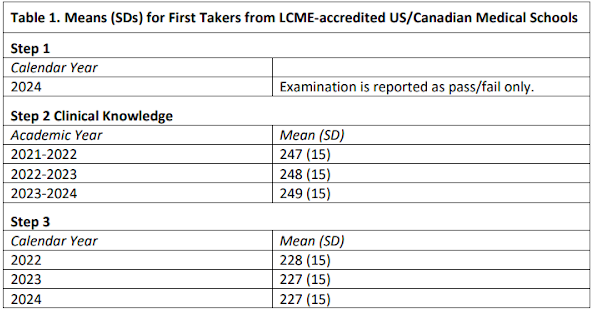
For Step 1, the concepts are difficult but often much more abstract, and students have usually not been exposed to a wide variety of pathology yet.
For Step 3, most matched residents not attempting to apply to fellowship are riding the ‘P=MD’ or ‘70=DO’ train pretty hard and there is little incentive to do more than pass.
Step 2 CK tends to be the highest-scoring exam because students are never more competent in clinical knowledge for a wide variety of specialties than they will be at the end of their third year of medical school, upon completing their core clinical rotations. Additionally, students have been sharpened by shelf exams digging deeper into the details for each speciality than the preclinical years.
Classically, one likes to do ‘slightly better’ on Step 2 CK than they do Step 1, but for those who have not gotten the score they wanted on Step 1, Step 2 CK provides a major opportunity to make a statement right before applications go out.
I have several friends who had mental or physical ailments provide a roadblock on Step 1 only to absolutely kill it on Step 2 CK and match into some very good specialties in some very competitive places.
What is the Step 2 CK Passing Score?
The USMLE Management Committee conducted a review of the USMLE Step 2 CK passing standard and decided that a four-point increase in the passing standard—used to determine a Pass or Fail outcome—will apply to Step 2 CK examinees testing on or after July 1, 2025.
On the three-digit score scale, the passing standard will change from 214 to 218.
What Qualifies as a “Good” Step 2 CK Score?
Based on recent data, the 50th percentile corresponds to somewhere around a 245, and all but those trying to compete for very competitive specialties or very competitive locations can feel generally happy with a score around the top of the bell curve. The 75th percentile corresponds to around 255 and at this point, anything above that is gravy.
The 25th percentile corresponds to around the score 235. Most students should aim to have this as their floor, if possible, especially international medical graduate students.
A “good” score depends on your individual profile, what specialty you want to apply to, where you want to apply, and what school you attend.
For example, consider the somewhat exaggerated case of two similar students trying to match into a general surgery residency:
Student #1 is in a US MD school trying to apply to rural residencies in the Midwest and Southeast.
Student #2 is in an IMG school trying to apply to residencies in his home state of California.
Student #1 has inherent advantages in his school profile and is attempting to apply to an area that is traditionally less competitive. Student #2 has a higher ladder to climb as an IMG and is attempting to match into a very competitive environment. The former student likely only needs to approach the top of the bell curve to feel fairly comfortable moving forward, while the latter has a lower risk tolerance because a score below their desired range may prove to be difficult to overcome.
What Step 2 CK Score Do I Need to Secure Residency Interviews?
The mean Step 2 CK score for United States MD seniors who matched into residency in their preferred specialty in 2024 was 250, so you can consider this number a general ballpark for your target score.
But remember, that this is the mean score and not a minimum! We discuss this in greater detail below.
Furthermore, there is not much difference in Step 2 scores for matched and unmatched grads. These statistics provide valuable insight, demonstrating the Match is more than just a score.
From Program Directors
According to the 2024 NRMP Program Director Survey, most programs require a pass with only roughly one-third of programs requiring a target score.
Additionally, the majority of program directors (83%) stated that they would consider applicants’ Step 2 CK scores as part of their overall competitiveness. For a full breakdown of the factors that contribute to deciding who to interview, see the chart below from the 2024 NRMP survey:
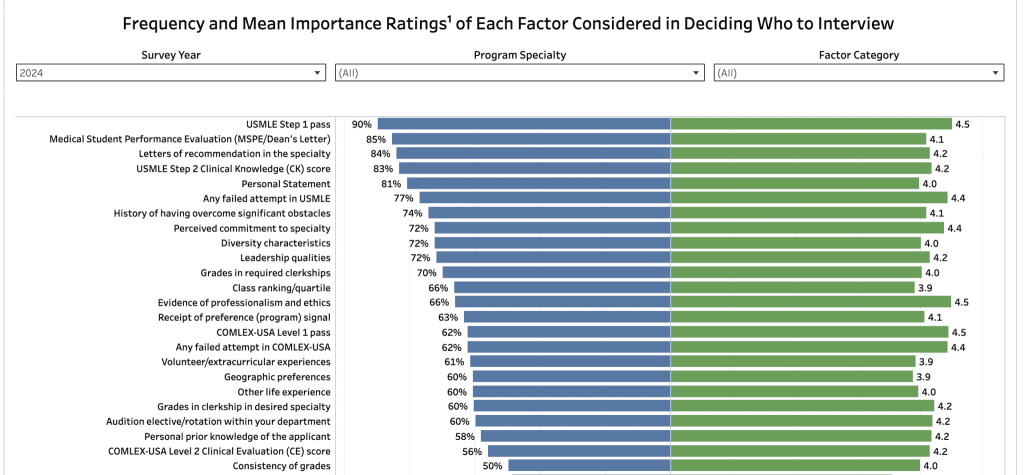
As mentioned above, there are several factors involved in what your Step 2 CK score should be: your goal, your stretch goal, and your floor score where you do not proceed to take the exam.
Additional Data
The NRMP offers Step 2 CK score data by specialty for matched and unmatched applicants. These tables are great guides, but not all encompassing. Applicants with scores below the average Match score match all the time (otherwise it would be the minimum matching score not the average match score). And those with strong scores do occasionally get dealt an unlucky hand come application time.
Use these as a guide and in concert with an advisor from your school, a mentor from your specialty, or one of the tutors working with you at Blueprint!
The Big Picture
At the end of the day, it’s important not to fixate so much on numbers. Of course, that’s easier said than done when it feels like your future as a physician now rides on just one 3-digit score.
That’s not exactly the case, however. Your future is built on where you go to medical school, what research you get excited about and involved in, and which extracurriculars you engage in, along with your letters of recommendation. It is built on how you choose to set yourself apart and not on how focused you were on one single exam for all of medical school.
This is not a game of you vs. USMLE. It’s the journey of becoming a physician who cares for humans when they are at their most vulnerable. All this to say, prepare for the USMLE as best you can, but don’t conflate a number with your drive, determination, and value as a future physician.
If that wasn’t enough to encourage you, don’t forget that you will have had the enormous challenge of Step 1 under your belt before you will need to tackle Step 2. And by Step 2, you’ll already have some experience to make your exam more like recalling information and less like memorizing a textbook. As always, we’re here to help you plan your studies and stay on track!
Looking for more (free!) content to help you pass Step 2 CK? Check out these other articles on the Med School blog: