

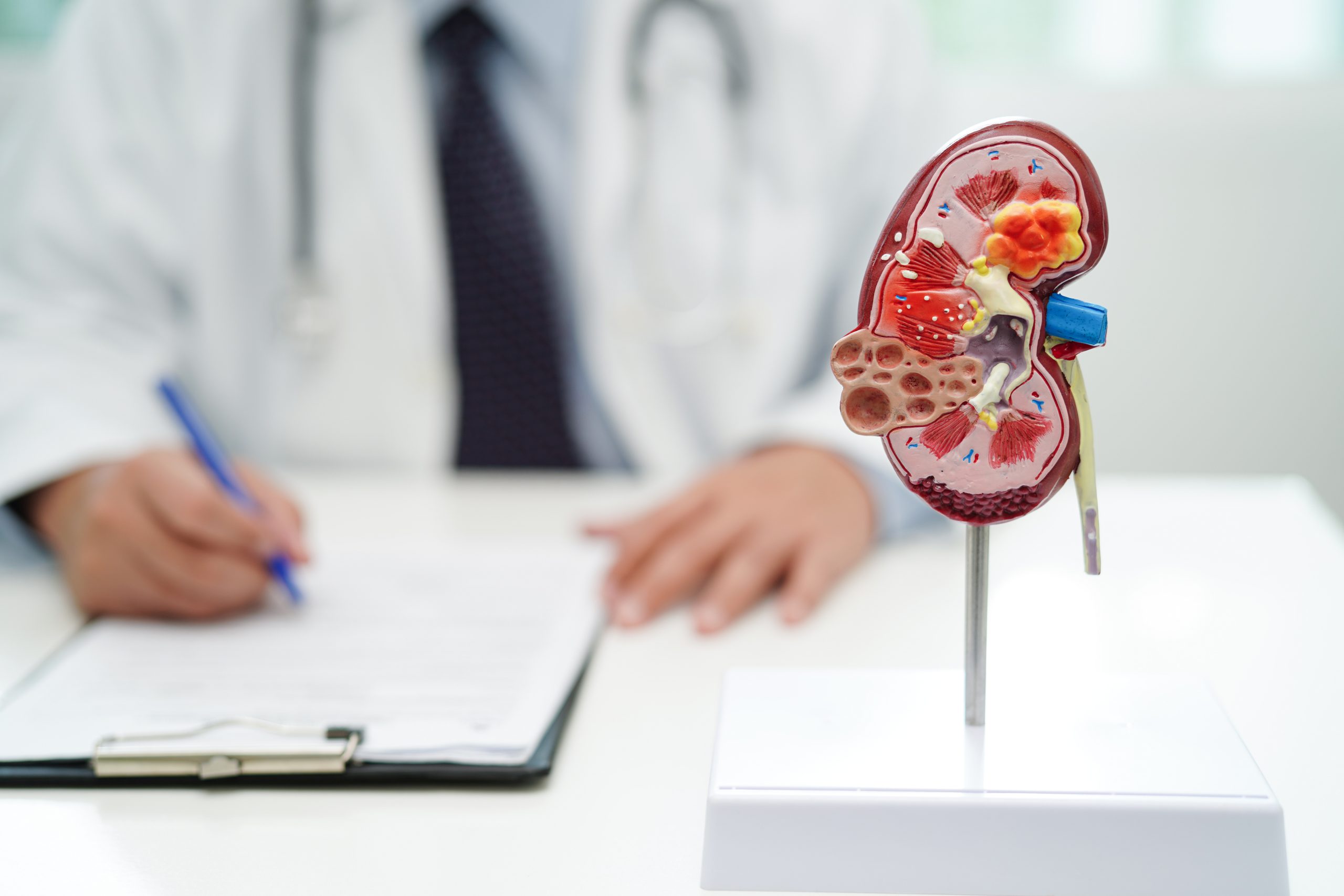
Ask any nephrologist—they will tell you that renal function is all that matters. Well, it’s pretty important for your Step 1 studying, too. From regulating electrolyte balance to dumping out life-threatening toxins, the kidneys are the unspoken heroes of the human body—and deservedly so, because they are complex machines with several moving parts.
While it is a truly exciting organ system, it can be equally overwhelming to learn about as a medical student. Let’s talk about some basic renal physiology frameworks and get a taste of what can happen if this physiology gets wacky!
High-Yield Renal Function Topics for Step 1
Basics of Normal Renal Function
The kidneys are composed of a couple million nephrons. The nephron contains an entrance where blood enters through the afferent arteriole into the glomerulus where blood is filtered into the tubule of the nephron. Blood pressure drives blood through the glomerulus, some of which makes its way through to become filtrate, the rest of which exits via the efferent arteriole. Through the tubule, substances are secreted and reabsorbed. The filtrate then heads to the collecting duct, where it funnels into the ureter, bladder, and ultimately to the toilet (or foley or diaper).
Like all organs, to prevent ischemia and subsequent injury, the kidney needs oxygen. Oxygen comes from blood, which is delivered to the kidneys by cardiac output. If anything gets too complex, think back to this: your basic understanding of the structure of the kidney.
Nephron Physiology
The name of the game when it comes to compartmentalizing the nephron is knowing the type of ion channel and the drug(s) that work there.
The proximal collecting tubule is the main site of reabsorption. It is here that all of the glucose (in a non-diabetic) and most of the sodium, chloride, bicarbonate, phosphate, water, and potassium get reabsorbed. Think carbonic anhydrase and SGLT2 transporters!!
The thick ascending limb of the loop of Henle contains the Na⁺/K⁺/2Cl⁻ cotransporter. Ions can pass through, but water cannot. This segment is critical for establishing the medullary osmotic gradient and is where loop diuretics (e.g., furosemide) act.
The distal (convoluted) tubule has a Na/Cl channel and again, no water channel. Thiazides work here, and notably, increase calcium absorption (an important side effect of thiazide diuretics!).
The collecting tubule is a specialized sodium channel (ENaC) and the V2 channel. Potassium-sparing diuretics work here to excrete sodium and water, and hang onto potassium. ADH acts here to hold onto water.
| Part of Nephron | Role | Diuretics at this Site |
| Proximal Convoluted Tubule | Bulk Solute Reabsorption | Carbonic Anhydrase Inhibitors |
| Loop of Henle | Reabsorption of Water and Salt | Loop Diuretics |
| Distal Convoluted Tubule | Secretion and Fine-Tuning Ion Concentrations | Thiazide Diuretics |
| Collecting Duct | Urine Concentration | Potassium-Sparing Diuretics |
Renin-Angiotensin-Aldosterone System
This system is so important that a relatively in-depth description is necessary. The renin–angiotensin–aldosterone system is a core regulator of blood pressure, circulating volume, and glomerular filtration.
Renin, a protease released by juxtaglomerular cells of the afferent arteriole, is secreted in response to decreased renal perfusion pressure, decreased sodium delivery to the kidneys, and increased sympathetic tone. Renin cleaves angiotensinogen (from the liver) into angiotensin I, which is then converted to angiotensin II by ACE, primarily in the lungs. Angiotensin II is a potent vasoconstrictor that preferentially constricts the efferent arteriole to maintain GFR and stimulates aldosterone secretion.
Finally, aldosterone acts on the distal tubule and collecting duct to increase sodium reabsorption and potassium excretion. The net effect of RAAS activation is increased blood pressure and increased circulating volume.
This system becomes exquisitely important because there are several drugs that target molecules within the RAAS system, like ACE inhibitors that block the formation of angiotensin II and aldosterone antagonists that limit sodium and water retention.
Key Clinical Connection: Sympathetic overactivity and activation of the RAAS system is implicated in the pathogenesis of heart failure. The body hangs onto too much water because of poor kidney perfusion, causing congestion and increased afterload/fluid overload for the already suffering heart.
Electrolyte Abnormalities
Good luck admitting your medicine patient and not coming across at least a few electrolyte derangements in their problem list. When kidney function goes awry, electrolyte abnormalities can be a life-threatening complication. Let’s talk about the ones that really matter:
HYPOnatremia is a dangerous abnormality that, if severe and/or acute, can lead to seizures and coma. If corrected too quickly, it can lead to permanent neurological damage (Osmotic Pontine Demyelination). To be on the safe side, aim to correct Na by 6-8 mEq/mL over a 24-hour period. Breaking down the etiologies of hyponatremia can be a separate blog post of its own, but remember the big three categories of hypovolemic, euvolemic, and hypervolemic hyponatremia as a basic framework.
Another true foil is HYPERkalemia. This can destabilize cardiac cellular membranes and lead to EKG changes and lethal arrhythmias. If this happens, it’s important to first stabilize those cardiac membranes with calcium gluconate, and then treat with insulin, glucose, and then get rid of the extra potassium either with a loop diuretic or with an oral potassium binding agent. If you are in a real bind, dialysis can get the potassium out of the blood.
HYPERmagnesemia can depress deep tendon reflexes, cause hypotension, and even cardiac arrest. The classic case is a pre-eclamptic who is on too high a magnesium infusion.
When it comes to calcium, high levels lead to the classic “bones (pain), groans (GI discomfort), (kidney) stones, and psych overtones” – a set of lab findings seen often in primary hyperparathyroidism.
Low levels, on the other hand, cause muscle spasm and tetany.Key physical exam findings to look out for in HYPOcalcemia include Chovstek sign (twitching of the face when you tap the facial nerve) and Trosseau sign (involuntary hand and wrist muscle spasms after inflating a blood pressure cuff).
Acute Kidney Injury
So how does renal function become damaged??
Kidney injury is common, and is a huge source of morbidity for both hospitalized patients and outpatients alike. I don’t make many promises when it comes to your USMLE exams, but I can promise you that some element of renal failure will show up on the test. More important than understanding any particular lab values or etiology is comprehending what drives renal failure from the pathophysiologic perspective, how these patients present, and how the different etiologies are treated.
We will use the terms renal failure and kidney injury relatively interchangeably; in reality, renal failure is more of an end-stage kidney injury. Kidney injury represents a decrease in the filtering function of the kidney – a lowering of the glomerular filtration rate (GFR). As the GFR (function) of the kidney worsens, the creatinine rises. Less creatinine is filtered into urine, and more hangs out in the blood, appearing on a basic metabolic panel blood test. For now, don’t worry about specific numbers and cutoffs, just realize that a rising creatinine represents poorer kidney functioning.
Why would the kidneys stop working as well as they once did? There are three big categories of renal failure, and to avoid frustration on the clinical wards, you must understand that a particular patient’s kidney injury can fall into more than one category, and categories can overlap (more on that later). For your USMLEs, though, your three big categories are “pre-renal,” “intrinsic renal,” and “post-renal.”
What would make you think a patient is suffering from renal failure?
Decreased urine output is the most classic of symptoms. Because the patient’s kidneys are having trouble making urine, you can expect to see fluid overload in the forms of peripheral edema, ascites, pulmonary edema, and pleural effusions. In labs, certainly look for a rising creatinine and BUN. When in doubt, always obtain urine studies, including a microscopic look at the urine itself. Finally, the presence of different types of casts can be pathognomonic for particular diseases (more on this below!)
1. Pre-Renal Failure
Pre-renal failure is a compromise of blood flow to the kidney, and is usually a function of dehydration. Your classic pre-renal patients are either suffering from a GI bug (vomiting and diarrhea), hyperemesis gravidarum, or overdiuresis. Renal ischemia can be caused by any compromise in feeding the kidney oxygenated blood. If lack of fluid/blood flow to the kidney continues long enough, the kidney can get ischemic, like in septic shock. If it goes on for long enough, it can start to have more of an ATN picture (which is an intrinsic cause of renal failure). The overlap of these two causes can drive students nuts. Don’t let it get you down, just realize that both can exist separately, but often overlap.
HY Clinical Scenarios:
- Severely dehydrated G1P0 at 7w3d
- Elderly patient found down at home with poor oral intake for several days
- Marathon runner with muscle cramps and dark urine after minimal fluid intake
- Burn patient with large surface-area burns and third-spacing of fluids
- Septic patient with hypotension and cool extremities early in the course
- Postpartum patient with acute hemorrhage and oliguria
Treatment Principles: Your patient needs some IV fluids or blood. Give it back to them!
2. Intrinsic Renal Failure
Intrinsic renal failure refers to diseases that damage the actual parts of the nephron – the glomerulus, the tubules, and the interstitium. While this is most commonly caused by drugs (antifungals, aminoglycosides, vancomycin – to name a few) or by prolonged renal ischemia, let’s take a closer look at how each disease specifically damages different parts of the nephron:
Glomerular Disease
These are the nephritic and nephrotic syndromes that can always be tricky to distinguish. Briefly, nephritis means inflammation at the level of the nephron, and nephrosis means 3.5+ grams/day of proteinuria.
Pure nephritic syndromes committed to memory include PSGN, IgA nephropathy, and rapidly progressing glomerulonephritis (including Goodpasture and Wegener’s/granulomatosis with polyangiitis).
High-yield nephrotic syndromes include minimal change disease (very common, usually in children), amyloidosis (multi-organ involvement), FSGS, and diabetic glomerulonephropathy. There’s a lot of nitty gritty detail contained in these diseases, and many others that we haven’t talked about. More than electron microscopy and other esoteric findings, focus on the disease process and pathophysiology. The rest will come with each pass through the material.
Acute Tubular Necrosis AKA Tubular Disease
Severe hypoxia, decreased forward flow (i.e., heart failure, hemorrhagic shock), anemia, and hypotension can all cause renal tubular ischemia, ATN, and intrinsic kidney failure.
Acute Interstitial Nephritis
Commonly a hypersensitivity reaction to drugs (NSAIDs, penicillins/cephalosporins, sulfonamides), this disease presents with a classic triad of fever, rash, and eosinophilia (along with evidence of an AKI, of course).
Casts
While cast formation in urine might not be of the highest yield, its ability to cinch a questionable diagnosis make casts too juicy to pass up. In order for a cast to form, a certain substance must coalesce inside the tubules in the kidney. Therefore, there must be an intrinsic renal process occurring for a cast to form.
- WBC casts in the urine means a likely “urinary tract infection,” but not until there are white blood cells in the kidney itself (pyelonephritis), do we get casts. These can also be seen in acute interstitial nephritis.
- RBC casts mean blood making its way into the tubule, usually from glomerulus breakdown from glomerulonephritis.
- Muddy brown/granular casts are the result of tubular cells sloughing into the ducts, seen in acute tubular necrosis (ATN).
HY Clinical Scenarios:
- ICU patient with prolonged hypotension who now has muddy brown casts
- Patient treated with aminoglycosides who develops rising creatinine days later
- Septic shock patient whose creatinine continues to rise despite fluids
- Child with cola-colored urine two weeks after a strep throat
- Diabetic patient with long-standing disease and heavy proteinuria
Treatment Principles: Intrinsic causes are often the hardest to treat; supportive care is king until the kidneys heal and start to put out urine again. Start by discontinuing any nephrotoxic agents, and working to encourage forward blood flow with inotropes if the heart is not functioning so well. Treatment of any etiology involves reversing and treating whatever the culprit is, and supporting the patient along the way.
3. Post-Renal Failure
As it sounds, the problem in POST-renal failure occurs AFTER blood is filtered through the kidney to form urine. If the passage of urine from the collecting duct to the toilet is obstructed, filtrate will back up in the tubule, flood the kidney, and injure it. Everything in the body depends on flow, and if filtrate can’t make its way out of the kidney, the kidney will get injured.
Working from distal-to-proximal, sources of obstruction can be clogged/clamped urinary catheter, obstructed distal urethra, obstructed prostatic urethra (BPH or cancer), renal calculus, or abdominal mass causing external compression of the ureter. Patient history and physical (and imaging, like renal ultrasound) will be most helpful in figuring out what is causing the problem.
If you are not sure what’s going on, placing a Foley can help to take post-renal obstruction off the list, and will also help keep track of inputs and outputs while the patient is being treated.
Treatment Principles: If something is obstructing, get it out of the way. Break up that too-big-to-pass stone, or call your urology colleagues to swiftly navigate a foley through the hypertrophied prostate.
Final Thoughts
I know that’s a ton of information all at once, and we haven’t even talked about singular disease processes! But the goal was to fill in whatever gaps in a big-picture, forest-for-the-trees, 30,000-foot view that you had, in order to comprehend what’s going on in normal kidney function and kidney injury. You are off to a great start, and have the framework to hang individual diseases onto.
A final tip in studying the renal system. Because it is so intimately intertwined with the cardiovascular system, do what you can to study these two systems close together. They are literally inseparable!
For even more high-yield Step 1 topics, check out these other posts on the blog:
- Now, That’s What I Call High-Yield: Pharmacology
- Now, That’s What I Call High-Yield: Musculoskeletal
- Now, That’s What I Call High-Yield: Neurology
Originally published February 2022 / Updated December 2025 by Avni Patel