


As a residency counselor, I’ve had many students come to me with the worry that they’re at a disadvantage because they don’t have physicians in their family or personal connections who can introduce them to different fields of medicine. They tell me that it feels like everyone else already knows someone in dermatology, orthopedic surgery, or cardiology. Meanwhile, they’re just trying to figure out how to pass first-year courses. (Which is good, because that should be their main focus anyway!)
The good news is that although having connections certainly helps, you don’t need them to make your specialty decision. If you have curiosity, a willingness to ask questions, and a systematic way to evaluate each specialty you encounter, you have what it takes to find the right one!
In this post, we’ll review how to ask doctors for shadowing opportunities, show you how to prepare for them, and give you some guidelines on where you should be each year of med school when it comes to choosing a field of medicine.
We’ll also give you some tips on how to make the final decision, and what factors it’s important to take into account when you’re choosing a specialty.
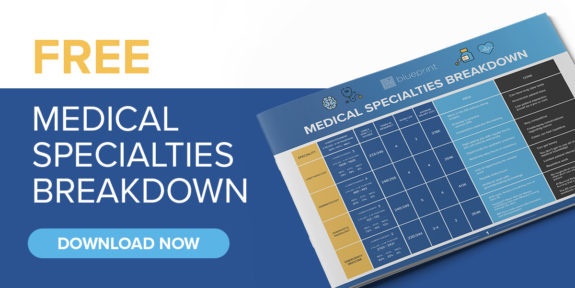
Looking for more of a clear breakdown and side-by-side comparison of each medical specialty? Find your path in medicine with the FREE Medical Specialties Breakdown Guide! Go beyond the data with qualitative insights from residents, attendings, and tutors who have been in your shoes.
Why You Haven’t Fallen Behind Without a Specialty in Mind
But first, I’d like to begin by addressing a concern many first-year students have. Some feel like they’re falling behind because a few of their classmates did some shadowing as an undergrad and already have a specialty in mind. As you’ll see, there’s nothing to be worried about if you don’t have a specialty selected at this point. And in fact, there are certain advantages to waiting until you’ve started your training to begin the process of choosing a specialty.
Regardless of connections, most med students are still figuring out their path!
One frequent misconception about med students is that they already have a dream specialty picked out when they start their training.
In reality, most begin medical school with only a vague understanding of what physicians do on a day-to-day basis. Needless to say, few have given much thought as to what specialty they’d like to go into, and even fewer have made their final decision.
Even most students who did some shadowing prior to med school have a limited understanding of what certain specialties entail because they had limited access to practicing physicians. They’ve likely never met a pathologist, radiation oncologist, physiatrist, nephrologist, or pediatric subspecialist. There are so many medical specialties that it’s impossible to get a real sense of what’s out there based on any premed shadowing experience.
The bottom line is, don’t feel like you’ve fallen behind if you haven’t picked out a specialty or don’t have any shadowing experience. Choosing a career in medicine should be based on real experiences and thoughtful reflection of the evidence you’ve gathered. And you have access to resources as a med student that you didn’t have before, so now is a great time to get the ball rolling.
That said, there are some things to be aware of as you begin the process of choosing a specialty. First and foremost is to remember that you’re just testing the waters at this point.
Remember: Exploring a Specialty Isn’t a Commitment
The best piece of advice I give to students early on in their medical journey is that each specialty exploration is NOT a commitment. I’ve had students spend one afternoon with a surgeon and suddenly worry that they’re “leading people on” if they later become interested in pediatrics. You’re allowed to change your mind.
Furthermore, in the beginning stages, your goal isn’t to decide whether you’ll spend the next thirty years in that specialty. Your goal is simply to understand what doctors in that specialty do and if it’s interesting enough for you to shadow again.
Don’t rule out a specialty you haven’t experienced yet!
Many students dismiss entire specialties based on assumptions they’ve never tested or experienced for themselves. Someone might think pathology is “only looking at slides,” anesthesiology is “putting people to sleep,” or family medicine is “just treating flus.” These are simplified stereotypes that disappear quickly once you spend time with physicians in those fields.
Whenever you catch yourself thinking, “I could never do that,” replace the thought with: “What else can I learn about this specialty?”
How to Find Physicians to Shadow When You Don’t Have Connections
Usually, you don’t need to know a doctor beforehand to get a shadowing opportunity with them. Medical schools have lots of ways to connect students with physicians. Student affairs offices often maintain shadowing opportunities and specialty interest groups frequently organize shadowing events or mentorship programs. Clerkship coordinators, faculty advisors, and counselors can also introduce students to physicians who enjoy teaching.
If those options aren’t available, don’t be afraid to contact physicians directly. Many genuinely enjoy mentoring students, especially those who show initiative.
A simple email is often enough to introduce yourself and ask them for a shadowing opportunity.
That could sound something like:
“Hello Dr. Smith, my name is Sarah, and I’m a first-year medical student at State University. I’m interested in learning more about emergency medicine because I haven’t had much exposure to the field. I was wondering if you might allow me to shadow you for a morning or afternoon at your convenience. Thank you for considering my request.”
Notice what this email doesn’t do: it doesn’t pretend that emergency medicine has always been the student’s lifelong dream. It simply communicates curiosity.
If your school has an alumni network, I’d use it to find physicians you’re interested in shadowing. Alumni frequently enjoy helping students from their own institution and may be more willing to schedule informational conversations or shadowing opportunities.
This can be difficult as physicians are busy, but all it takes is one to say yes.
3 Things to Do Before You Shadow a Doctor
Once you get a shadowing opportunity, it’s important to get the most of it by going in prepared!
And the way to do that is to:
1. Start with some basic questions.
Before shadowing someone, ask yourself a few simple questions:
- What kinds of patients does this physician care for?
- What problems are they solving?
- What parts of their job might be interesting to me and how can I learn more?
Of course, you probably won’t have complete answers to these questions. And that’s okay, the point of shadowing is to learn more. Nevertheless, thinking about them will provide you with a framework for the experience and help guide your preparation.
2. Read about the specialty.
Shadowing becomes much more valuable when you spend a little time reading about the specialty ahead of time.
Imagine walking into an orthopedic clinic without knowing the difference between a total knee replacement and conservative management for osteoarthritis. Much of the day will feel overwhelming because you won’t understand why patients are there or why the physician is making certain decisions.
Instead, try spending just an hour beforehand reading about common orthopedic conditions and watching a short overview of joint replacement surgery. Trust me, the conversations will make more sense. You’ll recognize terminology, understand why imaging matters, and appreciate the physician’s clinical reasoning.
This kind of preparation doesn’t need to take hours. And if you’re interested, you’ll naturally want to learn more! (Which, incidentally, is a good clue the field might be for you.)
3. Go in knowing the basics.
To build on the previous point, try finding the answers to common questions students have about the specialty. (Save the ones you cannot answer for the preceptor.)
For example, beforehand try to know:
- What diseases does this specialty treat?
- Is most of the work inpatient, outpatient, or both?
- Is it primarily medical, procedural, or surgical?
- What procedures are common?
- How long is residency?
- Are fellowships common?
- What patient population do they primarily serve?
Reliable sources include specialty society websites, residency program websites, the AAMC’s Careers in Medicine resources, educational YouTube channels, podcasts hosted by physicians, and review articles written for students.
The goal isn’t to master the specialty. It’s simply to build enough background knowledge that you can follow what’s happening instead of feeling lost.
The bottom line is, shadowing becomes much more valuable when you spend just a little time preparing. Taking an hour beforehand to read about the specialty, review the common conditions it treats, and familiarize yourself with a few basic medical terms will help you get much more out of the experience. Putting in a bit of work beforehand may take some time, but it beats spending the day trying to figure out what’s happening.
Ask Questions That Go Beyond “What’s the Lifestyle Like?”
Let’s get into a bit more detail about what questions it’s best to save for the physician. Most of them expect students to ask about things like residency competitiveness or lifestyle.
Those questions matter, but some of the best conversations happen when you go deeper. Start by seeking to understand the daily work.
Try questions like:
- What does a typical day actually look like?
- How has your practice changed over time?
- What takes up more of your day than students realize?
- What surprised you after residency?
These questions often reveal aspects of practice that students never see. For example, a surgeon may explain that operating occupies only part of the week, while clinic, documentation, and administrative work consume much of the remaining time.
How to Evaluate a Specialty After Shadowing
After every shadowing experience, you’ll want to write your thoughts down while they’re still fresh.
(You don’t want to rely on your memory six months later).
Many students benefit from keeping a simple specialty journal where they rate each experience using the same categories.
After shadowing in a specialty, ask yourself:
- Did I enjoy interacting with these patients?
- Were the diseases interesting?
- Did I enjoy the procedures, or wish there were more (or fewer)?
- Did I like the pace of the day, or was I bored?
- Did I feel energized or drained afterward?
- Could I imagine developing expertise in these problems over many years?
- Would this schedule fit the life I hope to build?
Using the same framework every time helps you compare specialties more objectively rather than relying on vague impressions. Choosing a field of medicine is a big deal, so it’s important to make apples to apples comparisons.
How to Explore Specialties Throughout Medical School
Naturally, first-year students are typically doing different things when it comes to choosing a specialty than upperclassmen are. It’s important to understand that when you’re trying to decide what your next move should be and gauging where you’re at in the process relative to your peers.
Here’s breakdown of what you should be doing each year of med school when it comes to choosing a specialty:
MS1: Explore
As a first-year student, your job is not to choose. Rather, your job is to gain exposure.
Shadow as many different specialties as possible. Attend specialty interest group meetings. Meet physicians with different career paths. Listen to panels. Ask questions.
This is also a great time to identify mentors, but don’t feel pressure to pursue a specialty simply because you met a physician. A wonderful mentor can help you grow regardless of whether you eventually enter their field.
Most importantly, resist the temptation to eliminate specialties too quickly. Your understanding of medicine is still developing, and many fields will make much more sense after additional coursework and clinical exposure.
MS2: Narrow Your Interests
By second year, you’ll likely notice patterns emerging.
Maybe every time you shadow a procedural specialty, you leave energized. For example, you love the OR! Or perhaps you consistently enjoy thoughtful outpatient conversations and continuity more than acute inpatient care. Or maybe you like working with and treating kiddos. Either way, this is the stage to start exploring a smaller group of specialties in greater depth.
It’s also an appropriate time to seek longer-term mentors, participate in research if it aligns with your interests, and learn more about residency competitiveness and career pathways.
The goal isn’t to finalize your decision just yet, but rather to identify several specialties that genuinely fit your interests and then narrow from there.
MS3: Test Your Assumptions
Third year is higher stakes.
Students frequently enter clerkships convinced they’ll become surgeons, only to discover they love psychiatry. Others spend years planning on pediatrics before realizing internal medicine better fits their interests.
Clinical rotations allow you to experience the actual work rather than imagining it.
Pay attention to how you feel at the end of each rotation. Do you look forward to returning tomorrow? Did you enjoy the workflow? Could you picture yourself becoming exceptionally good at this work? Could you do this for years to come?
These experiences should carry far more weight than assumptions formed during the preclinical years. Think deeply because next year, you apply to residency!
4 Common Mistakes to Avoid When Choosing a Specialty
Before wrapping up, I’d like to cover a few pitfalls it’s important to avoid when choosing a specialty.
When deciding what field to go into, please remember the following:
1. Choosing a specialty based on a single characteristic
Some students focus only on income. Others focus only on lifestyle. Some become fascinated by one procedure while ignoring what fills the other ninety percent of the physician’s workday.
2. Allowing one negative experience to eliminate an entire specialty
Every physician practices differently, every clinic has its own culture, and every institution has unique workflows. A difficult afternoon with one physician doesn’t define an entire field.
3. Ignoring your own opinion
Friends, family members, classmates, and even mentors all have their own biases about different specialties. Listen respectfully, but remember that you’re choosing a career, not trying to satisfy someone else’s opinion.
4. Overlooking the diversity of each specialty
While there is great diversity across the specialties of medicine, there is also great diversity within them. Academic physicians, community physicians, private practice doctors, hospital-employed clinicians, rural practitioners, and subspecialists may all have very different careers while technically belonging to the same specialty. It’s important to keep that in mind when evaluating a particular field.
💙 For more insight to trusting your gut when choosing a specialty, check out: Finding Your Calling: A Guide to Choosing a Specialty Beyond Competition
Final Thoughts
You don’t need physician parents, insider connections, or a perfectly mapped-out career plan to find the right specialty. You simply need a structured way to learn from each experience to narrow down your field of interest.
Every physician you meet, every clinic you visit, every operating room you observe, and every patient interaction teaches you something about a specialty, and about yourself.
Over time, you’ll begin to notice patterns. Certain patient populations, disease management options, and a variety of cases will interest you. And then certain clinical diagnoses will keep your attention. Certain work environments will feel natural, while others won’t. Those observations are far more valuable than prestige rankings or secondhand opinions. Keep that in mind throughout medical school and your specialty choice will become less about finding the “perfect” field and more about discovering where your interests, strengths, and values naturally align.
Best of luck on your search. Keep the tips we’ve mentioned here in mind, and you’ll find the field that’s right for you!
Approaching Step 1 or Step 2 prep this year? Blueprint has got you covered with USMLE practice questions, detailed explanations, performance analytics, and more! 💙
🌟 Step 1 Practice Bundle – Includes 2 full-length USMLE practice exams with a total of 560 NBME®-formatted practice questions, plus 1,000 additional questions in a Qbank
🌟 Step 2 & Shelf Exams Qbank – Includes 5,500+ practice questions (1,500 Step 2 questions and 4,000 shelf questions across 8 specialties), plus 8 mock shelf exams!