

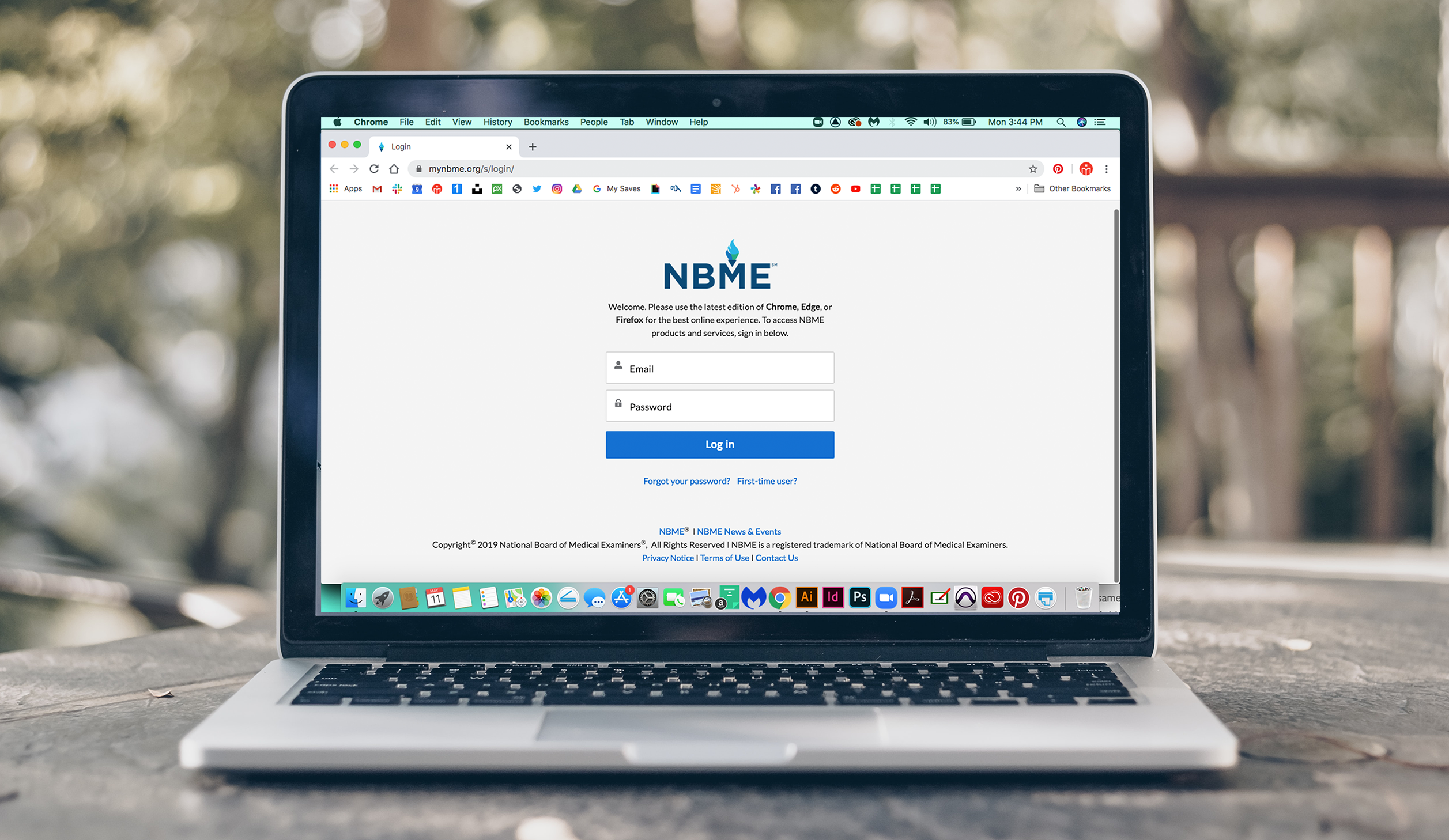
So, it’s your final week of Step 1 preparation. Congratulations! Are you wondering what you should do during the last week of studying? One resource I tell my students to use in the final week of Step 1 studying is the NBME Step 1 Free 120 simulation exam. It’s a great way to get ready as the clock winds down and you head into the final stretch!
In this article I’d like to explain what makes the Free 120 for Step 1 such a great study resource, one you should definitely take advantage of.
🗓️ Making your Step 1 study schedule? Check out Blueprint’s Med School Study Planner, the “smart” scheduling tool that will automatically plan out your study resources in just a few clicks!
What is the NBME Free 120?
The NBME Free 120 for Step 1 is a set of 120 questions given by NBME that you can utilize within their web interface. The NBME Free 120 is a free, official practice exam with 120 questions designed to familiarize students with the format and style of the USMLE Step exams, particularly Step 1. Note that there is a new Step 1 interactive testing experience that has shorter, 20 question, 30-minute blocks and updated functionality compared to the previous 40 question blocks.
The Free 120 simulates the exact format of the USMLE Step 1 question style and user interface. It’s six blocks of 20 questions timed exactly like the USMLE Step 1, gives you the exact same tutorial, and allows you to check your answers once you’ve finished.
The Free 120 for Step 1 was developed by the same team behind the actual USMLE exams, and is often considered to be high-yield and very representative of the actual USMLE Step 1 exam.
One Drawback of the Free 120 for Step 1
The major drawback of this simulation exam is that it only gives you a percentage correct and not a scaled score. Unlike the NBME Self-Assessments (NBME CSAs), the Free 120 does not provide a scaled score or likelihood to pass, so it shouldn’t be used as the sole indicator of readiness for the USMLE. (There’s a reason for this, but we’ll talk about that in a moment.)
3 Ways to Use the NBME Free 120 for Step 1 Prep
Now that we’re somewhat familiar with the NBME Free 120 is, let’s discuss how to use it and why it’s helpful!
1. Use the Free 120 as a test-day simulator 4-5 days before your actual test date.
This is a low-stress practice exam as there is no scaled score and it mimics the breaks, question style, and difficulty of Step 1 to a certain extent. It’s essentially a dry run of what you’ll do on test day and has no psychological impact on your prep, as it doesn’t give you a three-digit score.
One key reason you should take the Free 120 within a few days of your exam is that these questions have a chance to show up on Step 1. Remember, on Step 1, the graders (or computers that grade it) don’t care if you got lucky and picked the correct answer.
2. Utilize the test tutorial to save valuable break time on test day.
This exam mimics the interface you’ll see on test day. This includes the test-taking tutorial and interactive questions.
Seeing the tutorial before your test date will allow you to skip it on the day of the exam, which will save you 15 minutes of break time. Trust me when I say you’ll need all your break time, as it’s very important to break in between each block of 20 questions.
3. Acclimate to Step 1 interactive questions.
The interactive questions in the Free 120 include those where you listen with your stethoscope for a murmur or listen to breath sounds. Knowing how these will look on exam day will lessen your anxiety, as you won’t have to fidget around figuring out how to use these features. Less anxiety is always a good thing on test day!
Done with the Free 120 and looking for more Step 1 practice with questions just like the ones you’ll see on your actual exam? Check out Blueprint’s Step 1 Practice Bundle to get 2 full-length USMLE mock exams!
How is the NBME Free 120 for Step 1 scored?
As mentioned earlier, the Free 120 does not generate a three-digit score. It does give you a percentage correct. Some people have tried to correlate to a Step 1 passing score to percentage correct (more data can be found here). It seems the typical score to pass requires at least 60% of the questions answered correctly.
Anecdotally, I can say that if a student gets a 70% or higher on the NBME Free 120 Step 1, they generally pass Step 1. That’s from a small sample size of about 25-30 students/friends. In terms of actual score, again, there is no exact correlation between your percentage on the NBME Free 120 and your Step 1 three-digit score.
New NBME Free 120 Step 1 Question Explanations
To help you make the best of your time with the NBME Free 120, here are explanations for 25 questions. These are the first 20 questions in block 1 of the Free 120:
- A. Anti-citrullinated peptide antibody. The vignette tells of a 53-year-old woman with 6-years of hand stiffness and pain, accompanied by swan-neck deformities of her fingers in the accompanying photo, consistent with RA, which is confirmed with Anti-CCP Ab on blood test.
- B. Asymmetric smile. 80-year-old with right-sided paralysis, loss of vibration on the right, and an inability to abduct the left eye. The question mentions an infarction and with the symptom presentation as well as the diagram, you can piece together a pontine infarct, which would lead to involvement of cranial nerve 7 and ultimately a crooked smile.
- B. Factor V Leiden mutation. A 27-year-old female with acute onset SOB, tachycardia, decreased oxygen saturation, and a swollen calf indicative of DVT in the setting of her recent flight likely has a pulmonary embolism. Given her young age and increased risk of clotting, she likely has Factor V Leiden mutation, which is the most common inherited thrombophilia.
- C. HIV infection. This 32-year-old with a constellation of symptoms including 2 weeks of fever, LAD, sore throat almost seems like a mono infection. However, looking at the lab findings of decreased cell lines clue you into something much more serious as an active HIV infection.
- C. Interstitial inflammatory infiltrate. This 60-year-old has acute fever, joint aches and rash after staph endocarditis and subsequent antibiotic treatment. Additionally she has AKI, hyperkalemia with acidosis and WBC casts in the urine and eosinophilia. This presentation after prolonged antibiotic usage is classic for AIN, which will have Interstitial inflammatory infiltrate.
- D. Trauma. This 20-year-old woman with a 2 month history of progressive weakness in her arms in addition to recent headaches and back pain, decreased sensation and MRI findings of syringomyelia, likely associated with spinal cord injury trauma.
- E. Vascular obstruction by lipid-rich plaques. 68-year-old man with 6 months of back pain and leg cramping that improves with rest and his hyperlipidemia, diabetes and hypertension should clue you into peripheral artery disease of the lower extremities. PAD causes pallor and absent pulses on both sides and is caused by atherosclerosis which results in vasculature being obstructed by lipid-rich plaques.
- D. Fused commissures. 31-year-old woman comes to the ER for progressive SOB and signs of fluid overload – crackles, dullness to percussion. Her history mentions a childhood febrile illness likely hinting at rheumatic heart disease, which can lead to mitral stenosis and fused commissures.
- A. “Are there any reasons why you might want to quit smoking?” A 58-year-old with COPD should be counseled on smoking cessation and the most effective statement is to explore reasons and motivations to quitting with an open ended question.
- B. Caloric insufficiency. This 18-month-old is here for a well-child exam and has previously been healthy with appropriate milestones and no concerns from the parents. However, recently she has fallen to the 5th percentile for weight and her current diet consists of only 16oz of formula, which is not enough calories for this age group. FTT or failure to thrive is commonly caused by inadequate nutrition.
- A. Internal validity is the confidence with which you can conclude that a direct cause-and-effect relationship exists between your independent and dependent variables. High internal validity means you can confidently rule out alternative explanations or confounding variables for your observed results. It is improved by specific design techniques such as randomization, blinding, control groups among others. Yogurt is a source of calcium and adding it to the questionnaire would improve the validity.
- D. Reduviid bug. 40-year-old female that comes to your office after a positive T. Cruzi result. This is a straightforward question that provides the diagnosis for you and simply asks for the bug that causes it, which is the reduviid bug.
- A. “Help me to understand what you are hoping I can do for you today.” A 40-year-old man comes for acute abdominal pain and has refused prior diagnoses and medications. He is seeking medicare care repeatedly but declines treatments and the physician should ask for the patient’s expectations to better understand the situation while respecting patient autonomy.
- B. α₁-Adrenergic antagonism. A previously healthy 72-year-old man comes with 2 months of urinary symptoms and DRE shows a symmetric and diffusely enlarged prostate, likely indicative of BPH, which is best treated by a medication such as tamsulosin which blocks alpha 1a receptors to induce smooth muscle relaxation to alleviate symptoms.
- A. Bipolar disorder, manic, with psychotic features. A 33-year-old woman comes in with 2 months of delusions and hallucinations along with pressured speech and decreased sleep. Elevated mood such as this along with psychotic features is classic of bipolar.
- B. 63-year-old female with heartburn has her gastric pH levels monitored after receiving treatment. Omeprazole is a PPI with a slower onset but sustained efficacy while cimetidine is a H2 blocker with fast onset but shorter duration.
- B. Inferior vena cava. A 65-year-old woman with colon cancer has new mets. The question is basically asking how does colon cancer spread to the liver and lungs, and most commonly it spreads via the portal venous system and IVC.
- E. Scabies. A 4-year-old boy comes in with 3 weeks of rash that is intensely itchy on hands, in between the fingers, waist and thighs. The question describes it as thin serpiginous tracts in the epidermis that ends in small vesicle classic of scabies.
- E. Overload of unconjugated bilirubin. A 18-year-old woman with SCD has acute abdominal pain after eating a meal and gallstones visualized on US. The cholelithiasis is due to her overload of unconjugated bilirubin as SCD causes chronic hemolysis of the sickle RBCs by splenic macrophages. This RBC breakdown will leave excess heme which metabolizes into unconjugated bilirubin.
- D. Proto-oncogene. 34-year-old man with a history of pheochromocytoma comes for 1 month of diarrhea and a right sided neck mass that upon closer examination is found to be a neuroendocrine neoplasm of parafollicular cells. This is the classic diagnosis of MEN type 2A, which is caused by a mutation in a proto oncogene, the RET gene.
Further Reading
We hope this post helped you make sense of the NBME Free 120 and how to use it for Step 1 prep! For more Step 1 tips, check out these other posts on the blog:
- How Hard Is Step 1 Now That It’s Pass/Fail?
- The Step 1 Pass Rate Is Decreasing: How to Make Sure You’ll Pass
- When to Take USMLE Step 1: A Data-Driven View
Originally published May 2020 / Updated July 2026
Updated by Dr. Mike Ren