

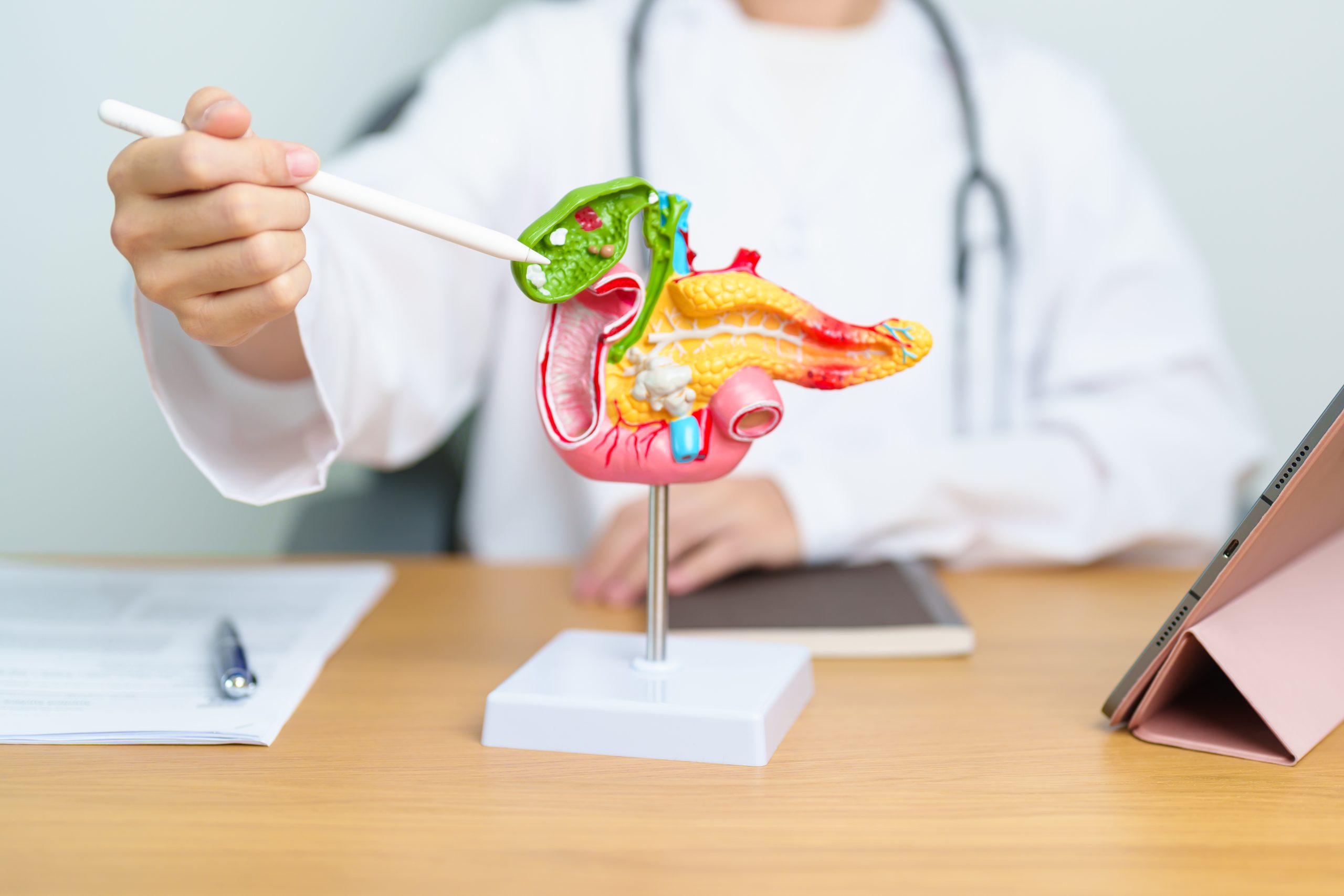
When teaching students and junior residents, I often discuss how most pathologies we encounter are due to either a blockage in a specific pathway or too much product being made from a pathway. This means that if one can remember the steps in a pathway, it becomes much easier to remember the causes and treatments of various illnesses. Additionally, understanding the principles of one system helps to understand other systems, as the causes and effects are often similar.
The biliary system is an excellent example of how pathways tie into the causes and treatments of illnesses, and conveniently, it’s also one of the most operated on systems we encounter.
In this article I’d like to illustrate how the biliary pathway is connected to various biliary illnesses, so you can see how a pathway/pathology heuristic can be used to understand the causes and treatments of illnesses in the biliary tree and more broadly.
Let’s begin by taking a look at how a rule regarding bilirubins can be used to map out where a problem lies in the biliary pathway.
Pathways and Pathology: A Tale of Two Bilirubins
There are two types of bilirubin, direct and indirect. The one that’s elevated often tells you where in the pathway the problem lies.
If indirect bilirubin is elevated, this indicates a problem that comes before the liver in the pathway, such as increased hemolysis.
If direct bilirubin is elevated, this indicates a problem after the liver that’s preventing bilirubin from passing into the duodenum, such as a gallstone in the common bile duct.
This rule can really help you pin down where a problem lies, what’s causing it, and therefore what a potential treatment could be.
That’s just a general rule you can use to connect pathology to points in the bilirubin pathway. Now let’s have a look at how different points in the biliary pathway are connected to specific illnesses and their treatments.
4 Biliary Pathway Blockages That Create Pathologies
Symptomatic Cholelithiasis
The first blockage on the biliary pathway occurs when a patient has gallstones or low gallbladder ejection fraction (yes, same idea as the heart’s ejection fraction) but there isn’t an active infection. These patients may present with right upper-quadrant pain after a fatty meal, but it dissipates with time.
The idea is that there’s a brief obstruction to bile flow or difficulty ejecting the bile itself. Imaging will likely show only cholelithiasis without other hallmarks of inflammation.
These patients often warrant obtaining a HIDA scan, a special imaging study that’ll tell you the ejection fraction (again, just like for the heart) of the gallbladder and if there’s delayed or absent filling of bile into the gallbladder, which would indicate a partial/complete cystic duct blockage.
These patients may be offered cholecystectomy if the “attacks” are interfering with their lives or if there’s risk of progression.
Analogy: You can think of symptomatic cholelithiasis as the “angina” of the gallbladder, in that it resolves on its own like angina in the heart.
Cholecystitis
When a patient presents with right upper-quadrant abdominal pain, an ultrasound or CT scan is often obtained, sometimes both.
What would you expect to see if bile is unable to flow out of the gallbladder (a sac with only one exit) and now there’s an infection? Gallstones, gallbladder distention, gallbladder wall thickening, and pericholecystic fluid all are indicators that the gallbladder is “sick.” When a stone sits in the cystic duct, bile and bacteria build up, leading to infection and infectious changes such as the wall thickening and the presence of surrounding fluid.
Analogy: This is similar to the etiology of appendicitis and diverticulitis.
A patient with this presentation may have leukocytosis (elevated white blood cell count) indicative of an infection that usually won’t resolve on its own, like a STEMI in the heart.
As indicated, this would be cholecystitis (-itis indicating inflammation). These patients need antibiotics, IV fluids, pain medications, and likely a cholecystectomy during that admission.
When it comes to a cholecystectomy, many are performed laparoscopically or robotically. As medical students, you’re likely going to be asked to describe the “critical view of safety,” which is a tool used to avoid damaging the common bile duct during a cholecystectomy.
The critical view of safety is defined as the following:
1. The hepatocystic triangle (the cystic duct, common hepatic duct, and the inferior of the liver) is clear of fat.
2. The lower one-third of the gallbladder is dissected away from the gallbladder fossa.
3. Two (and only two) structures (the cystic duct and the cystic artery) are shown to enter the gallbladder.
Choledocholithiasis
As you can imagine, gallstones are able to occasionally escape the gallbladder and travel down the common bile duct toward the duodenum, sometimes getting stuck along the way. If you were that gallstone and looked backward up the common bile duct, you’d see where the ducts enter the liver and that bile has begun to back up into it.
If that were happening, what lab abnormalities may you see? Elevated transaminases and total bilirubin (may lead to jaundice) are most obvious.
But what about direct versus indirect bilirubin? The blockage in choledocholithiasis comes after the liver where bile is conjugated, so you’ll see elevated direct bilirubin.
Additionally, when imaging is obtained you’ll likely see dilation of the common bile duct due to increased volume of bile in the duct. A normal common bile duct is age divided by 10 in millimeters (Someone age 40 will usually have a duct measuring 4 mm, for example).
Notice that “choledocholithiasis” does not have -itis in the name and therefore there isn’t an infection, so the white blood cell count will likely be normal. For these patients, we’ll do an ERCP (endoscopic retrograde cholangiopancreatography), which is when a scope is placed down the esophagus so the biliary system can be accessed.
Then we can remove any stones/sludge and do a sphincterotomy at the 11 o’clock position to improve flow through the system. After the ERCP, patients often undergo cholecystectomy to prevent recurrence.
Cholangitis
Finally, cholangitis is when choledocholithiasis turns into an infection (just as symptomatic cholelithiasis turns to cholecystitis). Patients with cholangitis can become extremely ill.
To diagnose cholangitis, we can use the The Charcot triad. This triad consists of fevers, jaundice, and abdominal pain. Reynold’s pentad is a similar tool which includes Charcot’s triad with the addition of mental status changes and hypotension.
In addition to elevated transaminases, bilirubin, and dilated common bile duct, these patients will also have leukocytosis.
Similarly to what we saw with choledocholithiasis, ERCP is necessary ( in an emergent fashion) followed by a cholecystectomy. These patients also require IV antibiotics to treat the infection.
If you were to obtain blood cultures (which you should as a part of the surviving sepsis campaign), E coli would be most likely to grow. These patients may require pressors and an ICU admission. Remember, they are septic.
The Unusual Suspects: High-Yield Biliary Variants
There are several specific conditions of biliary origin that are of note and are variations of the above.
These include:
Gallstone Pancreatitis
When a gallstone travels down the common bile duct (such as in choledocholithiasis), it may stop at the junction of the CBD and the pancreatic duct, which would cause pancreatic fluid to build up in the pancreas.
In addition to the labs associated with choledocholithiasis, these patients will have elevated lipase and likely severe abdominal pain in the epigastrum. This is the most common cause of pancreatitis.
Patients with gallstone pancreatitis likely require ERCP, pain control, and fluids. They should undergo cholecystectomy during the same admission once the pancreatitis has begun to resolve.
Gallstone Ileus
When an organ is inflamed, it tends to also cause inflammation of surrounding structures. This inflammation causes the wall to become thin between the structures and occasionally a connection forms, called a fistula.
In gallstone ileus, , a connection between the gallbladder and duodenum is known as a cholecystoenteric fistula. Here, a gallstone may “fall” down the small bowel and become lodged at the ileocecal valve.
Again, think about this in terms of the pathway. What would be the consequences of blocking the small bowel at this point? You’ll have dilation of the proximal small bowel, and decreased or absent bowel function (also known as a small bowel obstruction).
On imaging you’ll note a stone in the right lower quadrant, the dilated small bowel, and pneumobilia as air from the bowel enters the biliary system.
These patients require nasogastric tube decompression and usually surgical intervention. In this operation, the stone is milked proximally away from the ileocecal valve and removed via enterotomy.
Bouveret Syndrome
Bouveret syndrome is similar to gallstone ileus, except rather than the stone traveling distally to the ileocecal valve, it travels proximally and causes a gastric outlet obstruction.
Acalculous Cholecystitis
The final malady on our journey is acalculous cholecystitis, which as the name indicates, is an infection of the gallbladder without evidence of gallstones. This condition is most often seen in patients who are critically ill or septic for another reason. In these cases, the body is unable to maintain the health of the gallbladder.
These patients are often poor surgical candidates and the gallbladder itself is not the source of the infection, therefore a percutaneous cholecystostomy tube is most appropriate. After the patient recovers (which often takes several weeks), a cholangiogram may be obtained to assess bile flow and there may be no need to perform a cholecystectomy.
Final Thoughts
I hope you enjoyed this brief summary of high-yield biliary pathology and treatments. Always remember to think in a systematic manner and where in the flow there’s a blockage. That’ll help you deduce lab values, signs, and symptoms of a given pathology.
The pathway/pathology connection is real! Understanding it can help you make more sense of the biliary pathway and the body as a whole.
For more high-yield content review for medical school and beyond, check out these other posts on the blog: