


Your fellow seniors just matched! You’ve known and rotated with them for the past few years and seen first hand how they stressed over applications, traveled for interviews, and second-guessed rank lists and now you’re celebrating their Match Day alongside them.
Suddenly, you realize, you’re next. How will you handle this 2026-2027 ERAS application cycle?
In this post, we’ll break down what to do during your MS3 year to set yourself up for success during residency application season. Let’s get started!
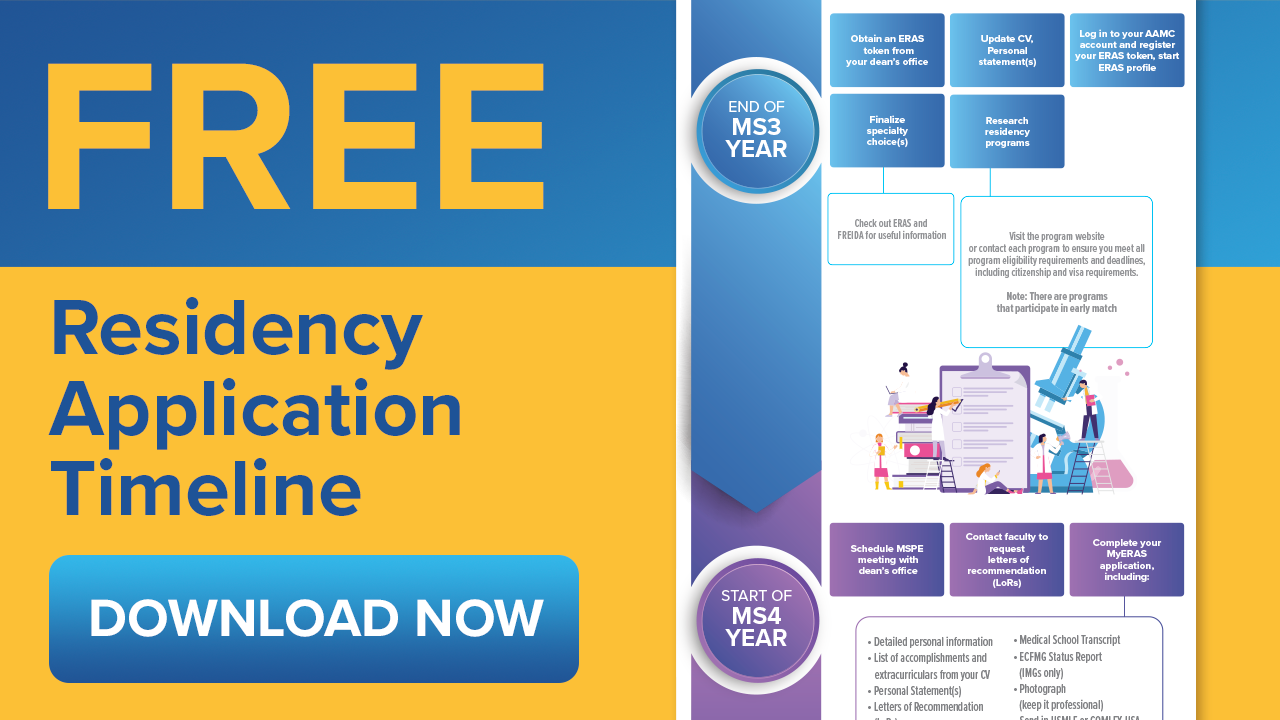
Starting your residency application can feel daunting, with a multitude of aspects to consider and the pressure to do well. If you’re applying to residency soon and aren’t sure where to start, download the FREE Residency Application Timeline to stay on track and make sure your top programs receive your very best residency application!
A Second Half of MS3 To-Do List
Lock in: The period between the second half of your MS3 year and the ERAS application opening in June is one of the most important parts of the ERAS 2026-2027 timeline. It’s a difficult time because everything converges at once, so you need to lock in and be on top of your game!
To help you stay organized, here’s an overview of things you’ll need to do during this crucial time.
1. Finish your core rotations and start electives.
During the latter half of your MS3 year, you’ll go from balancing your most important clinical rotations (i.e., finishing your core rotations) with starting electives in your intended specialty.
It’s a lot to handle, but you can do it! It’s important to stay organized and focused during this time, because your performance on these rotations can (and will) have a big impact on your residency applications.
2. Think about who you’d like to ask for letters of recommendation.
As you complete your rotations, start hunting for letters of recommendation from faculty in your desired field. Again, finish strong, because your performance today directly impacts any letters of recommendation you’ll get from the attendings you’re rotating with.
3. Make administrative and strategic decisions.
These include planning away rotations, refining your medical CV, and attempting to recall all of the volunteer work and leadership roles you had in the first year of medical school.
Try to think on and off about your personal statement and keep editing paragraphs in your head as you continue clinical duties and look for letters of recommendation.
5. Manage loose ends and professional pressure.
On top of it all, you may have your mind on that research conference you’re applying to, or that journal you’re waiting to hear back from. The second half of MS3 can be mentally exhausting when every day feels like an audition and you always need to perform at your prime.
The second half of your MS3 year is chaotic because you have to constantly juggle being a med student (already hard enough) with starting residency applications while being a young professional that’s trying to land letters of recommendation.
Yeesh, so it’s not just the workload that makes it tough, it’s the convergence of performance, decision-making, and uncertainty all happening at once!
6. Perhaps most importantly—use this phase of the ERAS 2026-2027 timeline to do a specialty gut check!
Up until now, your role has been to absorb as much as possible. You rotated through core clerkships, learned how different teams function, and started to notice what types of patients, workflows, and environments resonate with you.
But when you apply for residency, expectations change. Residency programs won’t evaluate how broadly you explored. Instead, they’ll assess how clearly you’ve committed to a path. You need to convey that narrative on your application and during your eventual interview.
7. Evaluate where you stand when it comes to selecting a specialty.
During the second half of MS3, most students find themselves in one of three positions: completely decided, leaning strongly toward one specialty, or genuinely stuck between two (or more) viable options.
That last group is far more common than most students like to admit. If you’re there, it doesn’t mean you’re behind the curve, but it does mean that in the next few months you’ll have to make some critical decisions. The difference between a strong application and a scattered one often comes down to how decisively you move through this phase.
How to Choose Between Two Specialties
If you’re torn between two potential specialties, don’t worry. As stated, this is more common than you think. What’s important is that you use the second half of your MS3 year to figure what field you want to go into.
Here’s a few tips that’ll help you make this big decision.
1. Choose the field that has a daily routine you enjoy.
One of the biggest mistakes students make is relying solely on memorable moments rather than lived experience. Let’s say you’re an MS3 deciding between general surgery and OB/GYN. It’s easy to remember the adrenaline of a trauma case or the emotional high of delivering a baby via vacuum or C-section, but those moments can be rare and don’t necessarily define a career.
Routine matters here, because it’s what you’ll be doing every day!
Therefore, they key questions you need to ask yourself when it comes to choosing a specialty are:
- What does a typical work day look like?
- What kinds of patients will you see over and over again?
Don’t just think of the zebra cases here. For general surgery, you’ll have plenty of appendectomies and for OB you’ll have way more SVDs compared to any super interesting or unusual zebra cases.
What type of environment do you want to be in? How much of your time is spent in the OR versus clinic versus inpatient floors? These are the realities that will shape your daily life in training and in practice, so be sure to properly weight them when choosing a specialty.
2. Reflect on each rotation.
For each rotation, take a step back and assess not just what you learned, but how you felt. There’s a difference between being tired because you worked hard and being drained because the work doesn’t fit your needs. That distinction becomes incredibly important when you imagine repeating that same experience for the next few years of residency.
For a detailed journey of how one MD chose a medical specialty based on rotation experiences, check out: How I Picked My Medical Specialty (By Crossing Off Everything Else)
3. Don’t try to adjust your personality to fit in.
Another important selection criteria (that’s often underappreciated) is the culture of the field you’re thinking about going into. Every specialty has its own rhythm, communication style, and expectations. Some environments prioritize efficiency and decisiveness, while others emphasize continuity and relationship-building.
If you find yourself constantly adjusting your personality to fit in, that’s worth paying attention to. The goal isn’t to just survive a specialty, but rather to feel like you belong in it and can work well alongside your peers.
4. Ask residents in the trenches what your daily life will be like.
A great way to glean additional insight is to ask those who have been there and done that. When seeking advice, be intentional about who you ask. Attendings offer valuable perspective, but they’re often far removed from the day-to-day realities of training. Residents, especially interns and junior residents are able to provide you a much clearer picture of what your life will actually look like in that specialty. Their insights into workload, stress, and unexpected challenges are often the most honest and actionable.
5. Go with the specialty you’d pick if all things were equal.
When you’ve gathered all the data, there’s one final question: if lifestyle, salary, hours and prestige were identical, which would you choose? The answer may be more obvious than you expect!
For advice on how to choose a specialty that truly fits you, check out: Finding Your Calling: A Guide to Choosing a Specialty Beyond Competition
What to Do Once You’ve Chosen a Specialty
Even if you don’t feel 100% certain after your gut-check (almost nobody does), it’s time to move forward. Keep in mind, you can always make a decision for your primary choice and, in some cases, a backup plan if you’re applying to a competitive field (see this list of the most competitive residencies and how to prepare).
Once you have a specialty lined up, you’ll have a better sense of how to build a cohesive application during the rest of your MS3 year.
At this point, your focus should shift to identifying gaps in your ERAS packet. For example, do you already have strong letters of recommendation in your chosen field from prior electives or core rotations? Perhaps you have them from your research mentors. If you have at least two or three letters from physicians you’ve worked with in your specialty, that’s great. If not, get to work finding mentors or taking electives/away rotations in your desired choice so that you’ll have some letters of recommendation.
Away rotations also come into play during this period, particularly if you’re pursuing a competitive specialty or hoping to match in a specific geographic area. Think of these rotations as auditions. They allow programs to see how you function within their team and give you a chance to evaluate programs from the inside. Because spots fill quickly, planning ahead is essential.
To identify any additional gaps in your ERAS application, critically review your materials to make sure you’ll be competitive in your chosen specialty. Have you had enough meaningful clinical exposure beyond your required rotations? Are there any red flags in your application that need to be addressed? Take care of these now when you still have time to make meaningful changes.
3 Things to Do the Summer Between MS3 and MS4
The summer between your MS3 and MS4 year is pivotal. Students who use this time well enter application season calm and prepared. Those who don’t often find themselves scrambling.
To make sure you’re ahead of the game, I recommend the following:
1. Get started on your personal statement.
This is one of the most important things you can do over the summer. Many students delay this because it feels overwhelming, but the goal isn’t perfection. You and your peers will likely write multiple drafts (sometimes dozens), so just start writing and see what you come up with.
Keep in mind, your first draft is simply a starting point. What matters is that you begin articulating why you’ve chosen your specialty and the experiences that led you there.
If you’re still between two fields, writing two separate drafts can be surprisingly clarifying and I’d recommend trying it if you have the time and the headspace. The version that feels more natural may point you in the right direction.
2. Secure letters of recommendation.
Asking early is always recommended. This allows your letter writers to reflect on your performance and craft something that truly supports your application. When you ask, come prepared with your CV and a draft of your personal statement (this is one of the main reasons to get started on it ASAP). The easier you make it for your letter writers, the stronger your recommendations will be.
3. Strengthen your ERAS experiences section.
This often gets overlooked, so be sure to use the summer months to build out the experiences section of your application. Take the opportunity to show depth and commitment to your chosen field. Document your clinical experiences, leadership roles, research, and volunteer work in detail, especially as it pertains to the specialty you’re applying for.
Write down specific examples and responsibilities now, while they’re still fresh in your mind. Waiting until later often leads to vague, generic descriptions that don’t do you justice.
ERAS 2026-2027 Timeline: Common Pitfalls to Avoid
1. Being indecisive
One of the most common mistakes students make during this period is being indecisive for too long. While it’s important to think carefully about your choice (I get it, it’ll determine how you practice medicine for the rest of your life), there comes a point where continued hesitation becomes counterproductive. Progress requires commitment even if it’s not perfect. Take the first step.
2. Allowing a single rotation to dictate your decision
Another pitfall is allowing a single rotation, whether good or bad, to carry too much weight in your decision making. One difficult team you rotated with or one inspiring mentor can skew your perception, but your decision should be based on patterns across experiences for the specialty. It’s important to realize you’re choosing to enter a particular field, so you need to think long-term rather than being swayed by a data point or two.
3. Ignoring your application’s weaknesses
It’s also important not to ignore weaknesses in your application. Whether it’s a lower Step/COMLEX score, a major gap, lack of research experience, or limited exposure in your chosen field, these issues are best addressed early, as they can impact your viability.
ERAS 2026-2027 Timeline: ERAS Opens
ERAS opens on June 4, 2026 and if prepared, your mindset will be very different from many of your peers. Instead of starting from scratch, scrambling to find letters, or trying to remember which leadership positions you held in MS1, you should be refining and polishing what you’ve already built.
By this point, you ideally have a solid personal statement draft, confirmed letter writers, a Step 2 score report, and a well-developed list of experiences for your CV. This allows you to focus on improving the quality of your application rather than rushing to complete it.
Students who enter June prepared are not only less stressed but they produce stronger applications. They have time to seek feedback from mentors, make thoughtful revisions, and ensure that every part of their application aligns with their overall narrative and that they present their best self to residency programs.
For a more detailed look at the full ERAS 2026-2027 timeline, check out: Navigating the ERAS Residency Application Timeline: The Ultimate Guide
Final Thoughts
This stage of medical training is uncomfortable because it requires you to make important decisions without perfect information. You don’t need absolute certainty to move forward, nor will you have it. What you need is thoughtful reflection, honest input, and a willingness to take a step forward towards residency.
Ultimately, clarity doesn’t come from overanalyzing every possibility, but rather from engaging with your choice and building your application over time. The work you do in these next few months will shape where you match and how confident you feel when you get there. Good luck!