


The voltage drop across Rd is 8 V. What is the current across Re?
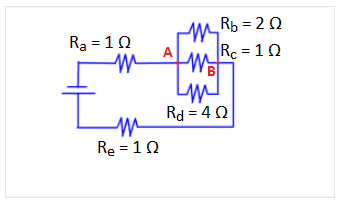
A. 2 A
B. 8 A
C. 14 A
D. 32 A
Click for Explanation
This problem requires 3 electrical circuit concepts:
1) V = IR, which relates voltage, current, and resistance
2) The fact that the voltage drop across resistors in parallel is equal in each resistor
3) Kirchoff’s junction law, which states that the sum of currents entering a node equals the sum of currents leaving a node
The voltage drop is equivalent for each resistor between red nodes A and B. The voltage drop across Rd is given as 8 V, and therefore the voltage drop across resistors Rb and Rc is also 8 V. Using V = IR for each resistor, the current in resistor Rb = 4 A, Rc = 8 A, and Rd = 2A. Using Kirchoff’s current law at node B: 4 A + 8 A + 2 A = 14 A. The current leaving node B equals the current across Re because there are no other nodes in between.
A. 2 A, incorrect, this implies that the current across Rd = Re.
B. 8 A, incorrect, this implies that the current across Rd equals the voltage and the current across Re.
C. 14 A, correct.
D. 32 A, incorrect, this answer incorrectly assumes a voltage of 8 V across Re and then uses a false relationship VR = I.
Want more MCAT practice?
We’ve got options for every schedule and learning style!
Whether you need the flexibility of a Self-Paced Course, the instruction of a live 515+ Course, or the 1:1 attention of a private MCAT tutor, Blueprint MCAT has the MCAT prep option that works for your learning style!
Get started with a free MCAT diagnostic, one free practice exam, and tons more MCAT prep resources.
Not sure which option is right for you? Schedule a free MCAT consultation with an MCAT expert using the form below. No obligation, just expert advice.