

If you’re reading this, I’m assuming you’re an IMG (international medical graduate). Maybe you’ve been in medical practice in the United Kingdom, or you’re a student enrolled in a five-year medical program in Pakistan. Perhaps you heard about medical practice in the US and developed a desire to come practice here. Now you’re wondering how to accomplish that, and where to turn for help.
We’re here to assist you. Let’s start with the basics!
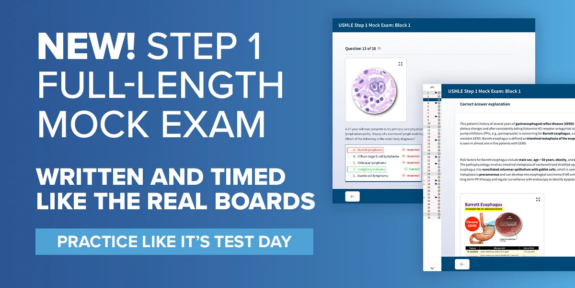
Preparing for USMLE Step 1 as an IMG? We’re here to help! Take a Step 1 mock exam to simulate exactly what test day will be like, and get a score report to help you understand what you need to work in on order to pass.
Why Is It Difficult for IMGs to Take USMLE Exams?
To get your US medical license, you must go through US residency training. Obtaining a residency spot in the US is difficult, but it can be done. You need to take (and do well on) the USMLE Step exams, starting with Step 1.
This means the first thing you’ll have to do is register for USMLE Step 1. Registering for your first USMLE can be difficult for IMGs. I’ve seen this firsthand. A large percentage of the students I counsel come from medical schools abroad. They’re often aware of the tedious process of registering for the USMLEs given they complete rotations in the US, have family/friends in medicine in the US, and often went to schools that specialize in producing graduates that practice in the US.
However, those of you outside of the Americas may need a bit more help starting the process. Registering for USMLE Step 1 is difficult for foreign students, especially because the instructions are sometimes difficult to follow for non-native English speakers. Those from other areas of the world might be less well-informed, or they might be in the middle of a busy medical practice and lack the time. This guide is for you.
Plus, find some of my top USMLE prep tips in this post, Our Top USMLE Tips & Tricks for IMGs Applying to US Residencies!
Before we begin, note that this is a long post. It has a number of detailed and nuanced steps. A lot of the information you’ll find here is online, namely from the USMLE and ECFMG official websites, or other blogs and forums. Some of the information available is valid, some was valid but now outdated, and some is just plain wrong. This post will likely need to be updated in the future.
For the most up-to-date information on the topic, always be sure to check out news from official sites such as USMLE.org and ECFMG.org. In fact, always check out the official source in order to verify your information. With that out of the way, let’s discuss how IMGs register and sit for the USMLE Step 1 exam, so they can begin their journey to practicing medicine in the US.
What IMGs Need to Do to Register for USMLE Step 1
In order to register for USMLE Step 1, you must establish an account with FSMB (Federation of State Medical Boards) AND have an accepted Application for ECFMG (Educational Commission for Foreign Medical Graduates ) Certification before you can apply for your first USMLE Step exam.
Here’s everything you need to do, spelled out in a series of steps:
1. Create your FSMB and ECFMG accounts online and apply for your identification number.
Go to the ECFMG website, scroll down and select IWA (interactive web applications). Then click the link for “If you have never been issued a USMLE/ECFMG Identification Number and want to request one.” The reason is that the USMLE program collaborates with Intealth (ECFMG) to verify medical school enrollment, graduation and/or ECFMG certification status, as required, as part of the USMLE eligibility verification process for each Step application. This means that your eligibility for ECFMG certification must be determined before you can register for a Step exam.
After you click the link, you’ll be hit with a wall of instructions on how to apply for your ECFMG/USMLE ID number. Follow the instructions carefully and diligently fill out the request form. The instructions mention special situations including naming conventions, that you should read through carefully as they may apply. Upon completing the form, you’ll get your ID number via email.
2. Begin the ECFMG certification application.
Once you have your ID number, you’ll be able to start on ECFMG certification. You have to pay for certification.
Regarding eligibility requirements, please note the following:
To be eligible to complete the application for ECFMG Certification, you must be either a graduate of or a student officially enrolled in a medical school located outside the United States and Canada that’s listed in the World Directory of Medical Schools (World Directory). Furthermore, the school’s listing must have an ECFMG note stating it meets eligibility requirements for its students and graduates to apply to ECFMG for ECFMG certification and examination.
To confirm that you meet these requirements, look up your school on the World Directory of Medical Schools website. Be sure to click on the sponsors tab for special circumstances that may apply to you. Be aware that in some countries, medical students must complete a period of internship and/or social service or fulfill other requirements, such as a thesis or state/national examination to be eligible for the final medical diploma and graduation.
Detailed ECFMG information and instructions can be found here.
3. Create a MyIntealth account.
MyIntealth is a new online environment for accessing services offered by Intealth and its divisions, ECFMG. MyIntealth services are used by providers pursuing ECFMG Certification and applying to U.S. graduate medical education (GME) or applying for J-1 visa sponsorship.
4. Complete the USMLE Step 1 application form and pay the fees.
Once you’ve completed the steps above, you should have your scheduling information.
Scheduling and Changing Dates
For the USMLE Step 1 exam, you’ll be asked to select an eligibility period, usually with a span of three months (for example May 1 2026 – July 31 2026). Ensure the eligibility period selected is appropriate for your situation and take into account preparation and travel logistics. Should you need to request an extension, you can request to extend your USMLE Step 1 eligibility period via ECFMG. There’s an extension fee. Note that if you already have a scheduled testing appointment during your original eligibility period and need to cancel and reschedule the appointment for your new, extended eligibility period, you must contact the Prometric testing center (discussed below) to cancel or reschedule that appointment.
Requesting an extension of your eligibility period does not change an already scheduled appointment, so you must cancel it if you need to reschedule. If your eligibility period is extended, a revised scheduling permit reflecting the extension will be issued. ECFMG will send you an email notification when your revised scheduling permit is available. You must present the revised scheduling permit at the test center on your exam date.
However, if you don’t take the exam during your original or extended eligibility period or if you’re unable to extend your eligibility period, you must reapply by submitting a new application. You may request an extension of your eligibility period only once for each exam. The time needed to complete the processing of your request may be contingent upon your medical school’s response to ECFMG’s request for verification of your status as a student or graduate.
Find a Testing Location
Select an available testing location that’s accessible to you. Keep in mind travel logistics including time, cost, and potential hassles. You don’t want to show up to an exam site jet-lagged, frazzled, and with thoughts of your expensive plane ticket and hotel stay.
Get to the test city well before you’re scheduled to sit for the exam. Relax, brush up on some studying, and focus on your exam day. A list of ECFMG testing sites can be found here.
5. Submit all other necessary documentation to the ECFMG.
Supplementary documentation includes medical diplomas for graduates. Official transcripts from your medical school and other forms of additional documentation based on various circumstances can be found in the lengthy ECFMG information booklet. Submit any additional documents as required, according to the instructions, to complete your application.
6. Get your scheduling permit and book a test date!
You’ll receive the scheduling permit by email. Review it and make sure your name is correct and other information about you is accurate because you’ll be required to bring the scheduling permit with you on exam day and it must match the information on your other identification.
To schedule your USMLE Step 1 examination, you must set an appointment using Prometric, the testing service that administers all USMLE exams. Schedule your exam by clicking here.
So that’s it for the sign-up process—now for some common questions I get asked as a tutor and residency counselor!
Answering Some Top Questions for IMGs
1. Why do I need to be ECFMG certified?
If you’re an international medical graduate and wish to enter an ACGME-accredited residency or fellowship program in the United States, you will be required to have ECFMG certification before you can enter the program.
The short and simple answer is that you need this certification to legally enter U.S. residency training, take USMLE Step exams, and obtain a full medical license as an international medical graduate.
See ECFMG certification in the ECFMG information booklet mentioned above. The reasoning behind this is that medical schools around the world have various educational and training standards. Some match the curricula at US medical schools, but most do not.
In order to verify quality of training and education, ECFMG certification can help assess whether graduates of these schools are ready to enter US residency and fellowship programs that are accredited by the Accreditation Council for Graduate Medical Education (ACGME).
2. Will my medical school be provided with data about my performance on the USMLE exams?
ECFMG provides international medical schools with data on the performance of their students and graduates on USMLE Step exams.
3. Can I request to have my USMLE results withheld from my medical school?
You can submit a request to ECFMG to have your individual performance data withheld from your medical school. Note that this request applies only to the reporting of your own individual performance data. If your medical school is eligible to receive aggregate performance data on its students and graduates, your results will not be excluded from the aggregate report.
4. Can I retake the exam?
The USMLE limit for retakes is four, which is the total number of times an individual can take the same Step exam. Those who have attempted an exam four times, including incomplete attempts, and have not passed are ineligible to apply again for any more USMLE exams.
All attempts at a Step exam are counted toward the limit, regardless of when the exams were taken. Furthermore, you cannot take the same examination more than three times within a 12-month period.You CANNOT retake a passing Step exam for a better score (not applicable to USMLE Step 1 as it is pass/fail). You can only retake an exam if you fail it.
5. How much will all of this cost me?
Exam registration fees and certification fees add up. For the most up to date costs, visit the ECFMG fees page.
6. Can I register for USMLE Step 1 and 2 simultaneously? How different are the two exams?
No. You must register for them independently and in order to be eligible for USMLE Step 2, you must have taken and passed Step 1 first. Here’s a brief overview of each exam.
USMLE Step 1
Step 1 assesses a medical student’s understanding and application of basic science concepts relevant to the practice of medicine. The topics include physiology, biochemistry and pharmacology, pathology, and immunology.
Check out the content outline here, with an included breakdown of each topic the exam will cover. This will help you build your study schedule. For US medical students, Step 1 is typically taken after the second year of medical school, and although the scores medical students once received on their Step 1 exams used to be a pivotal factor in deciding their residency match, the exam is pass/fail. Pass this one and you can move onto USMLE Step 2.
USMLE Step 2
USMLE Step 2 is meant to evaluate a student’s clinical knowledge and decision-making skills in the context of patient care. This exam includes questions based on clinical scenarios and requires you to apply your medical knowledge to solve problems including the diagnosis and management of common and esoteric diseases. Use the content breakdown to prepare for your exam, identify weaker subjects, and devote more time to acquiring knowledge in those areas.
USMLE Step 3
Step 3 is the final component of the USMLE series. It assesses your ability to diagnose and manage common clinical conditions across the various medical specialties. The exam is broad and covers a variety of subjects, ranging from pediatrics, adult and geriatric care, infectious disease, and rheumatology in both the ambulatory or hospital settings.
All the exams are computer-based and hosted at designated testing centers across the United States and select international locations.
Still have questions?
Detailed instructions are available throughout the application process. If you have additional questions, contact ECFMG. If you want to speak with me, feel free to schedule a free consultation!
Or, if you’re looking for some extra resources, check out these other posts on the Med School blog!
- 10 Common Mistakes on IMG Residency Applications and How to Fix Them
- Why Take a Step 1 Mock Exam (Even Though It’s Pass/Fail)?
- Step 1 Pass Rates Are Decreasing: How to Make Sure You’ll Pass
Originally published May 2024 / Updated October 2026