



From the time I started PA school, I always had a feeling that I would work in pediatrics post-graduation. And as fate would have it, that was my first rotation!
For me, starting with pediatrics felt like both a blessing and a curse. A blessing, because the little humans wouldn’t know if I wasn’t doing a “perfect” job. And a small curse, because the parents would be watching my every move!
Up to that point, the only practice “patients” I’d seen were my lab partner and a couple of family members. Whereas during my pediatrics rotation, I’d be picking up lots of babies (not something I was used to doing!) that would probably cry at the sight of me. What would I do when a kid was crying as I was trying to do an exam? I didn’t know how I would handle these situations.
In the end, it turned out to be an amazing experience. As someone who survived (and dare I say, thrived!) on her pediatrics rotation, let me share my tips, tricks, and study recommendations to help you do the same!
We’ll begin by taking a quick look at what a typical day looks like during a pediatric rotation to give you a good sense of what the road ahead looks like.
What to Expect During Your PA School Pediatrics Rotation
My rotation was at an outpatient pediatrics office in an underserved and very busy area. The office was open Monday-Friday from 8 a.m. to 5 p.m. (with an hour for lunch).
Myself and a couple of other PA/NP students would take turns seeing the children and then presenting to our preceptor. The preceptor was a physician, but 1-2 days a week there was an NP there to supervise us.
Appointments were maybe 15-30 minutes and ranged from same-day visits for illnesses to well-baby checkups. For the check-ups, there was a sheet you’d work through that listed the testing we needed to do for age-appropriate reflexes and activities.
The sheet also had information on necessary vaccinations and when they were due. I was able to give IM injections to some of the older children that needed vaccines.
My perceptor also performed some small procedures (particularly circumcisions), so I was able to observe and learn when they did those. The office also performed basic hearing and visual tests to identify any deficits.
During visits, we’d take time to educate the kids and their parents on the milestones that lay ahead. We also provided samples of different baby formulas and bottles to families in need.
What to Bring to Your PA School Pediatrics Rotation
It’s always best to be ready on day one when you start a rotation! When I started pediatrics, I brought the following:
1. A Stethoscope, Otoscope, & Pen Light
At my rotation I needed to have my own otoscope, which was no problem because I’d already gotten one for school. The problem came when I had to peer into those little ears, but more on that shortly! I also brought my own stethoscope and a pen light for evaluations.
2. Stickers
These are kids after all! It’s always a good idea to try and make the visits a bit more fun.
3. CDC Vaccine Cheat Sheet
Make/bring a chart on the CDC vaccine recommendation timeline, because you’ll use this every day!
4. Small Notebook & Pen
You’ll need these, trust me! It’s good to have them on you so you don’t have to try and find something to write on.
5. A Way to Keep Everything Organized
I ended up getting one of those foldable clipboards so I could keep my notes, the vaccine chart, and my milestones chart with me at all times. (I didn’t want the preceptor catching me off guard!)
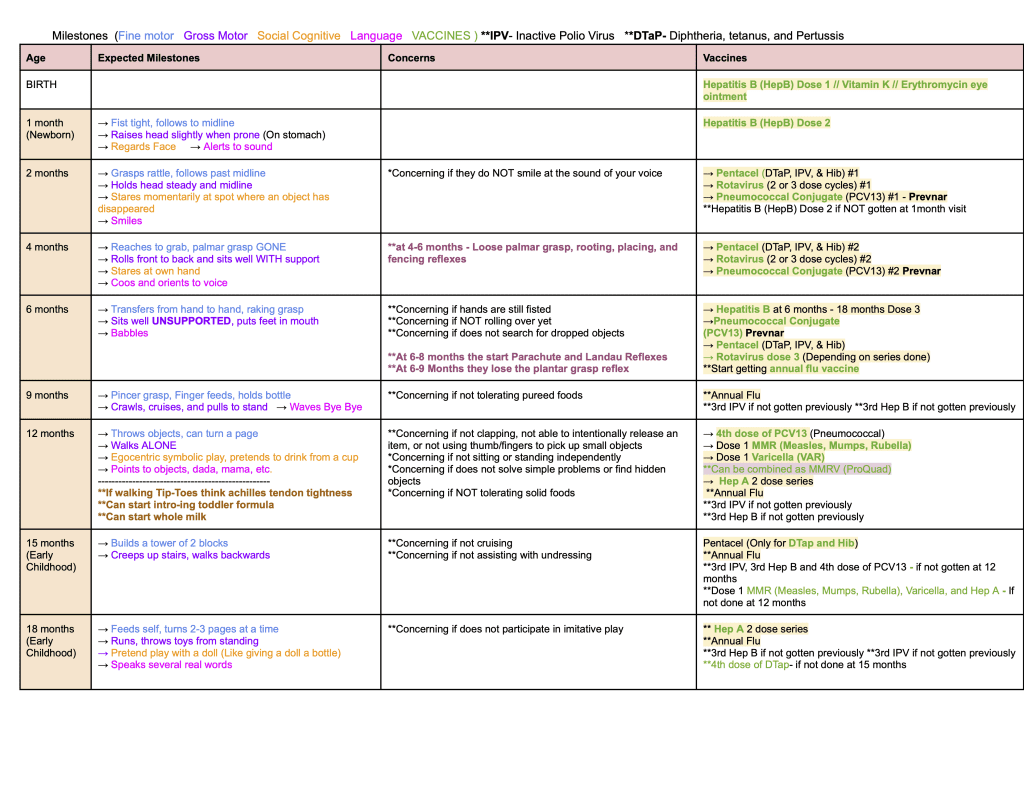
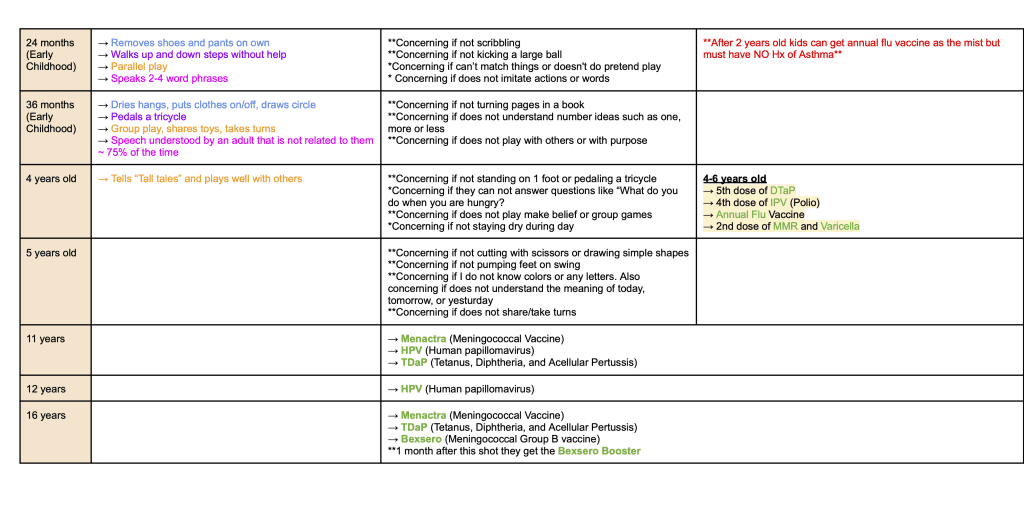
6. A Handmade Chart for Important Milestones
Finally, you may want to consider creating a chart that includes the milestones. Here is an example of what I made to give you an idea!
5 Practical Tips for PAs on Pediatrics Rotation
Pediatrics is unlike any other rotation, that’s for sure! The patients are different, and that has an important impact on how we provide care.
Here’s a few tips when it comes to treating kids:
1. You can’t go wrong with stickers and toys!
Consider bringing cute things like toys, the aforementioned stickers, etc. Attach one to your stethoscope if possible.
2. Nobody likes a cold stethoscope. Especially kids!
Try to warm the stethoscope before using it.
3. Check the lungs while they’re in a parent’s arms.
The best time to listen to the child’s lungs is when they’re sitting with their parent(s) before they start crying. A lot of the initial exam can be done with the baby still in a parent or guardian’s arms which helps decrease the crying.
4. Dress for comfort.
Wear comfortable clothing because you end up doing a lot of bending, squatting, kneeling, etc. Sometimes you have to get on the ground to evaluate the child in their car seat before they start crying.
5. Parents/guardians can help with ear exams.
When trying to do an ear check, have the child sit in a parent or guardian’s arms and ask the parent to hold the child’s head to their chest while you take a look. Trying to get a good look at a kid’s ears may be the hardest thing I did during pediatrics, but having another adult help out can make it a lot easier.
How to Study for Your Pediatrics End-of-Rotation Exam
The pediatrics end-of-rotation exam (EOR) was my first EOR in PA school, so I didn’t know what to expect. I found it challenging, but fair in terms of what was on it!
There are things that are unique to pediatrics such as viral exanthems, vaccine schedules, milestones, reflexes, etc. They can only test you on this stuff in this section, and they definitely do—so be sure to review those subjects thoroughly!
My advice for how to prepare is to start by gathering all the testable topics in a single place. I put everything in a chart and labeled the headers “Disorder, Etiology/Risk Factor, Patho/Complications, Symptoms, Diagnostics, and Treatment.” Then, I filled in the chart.
I organized it in a way that made it easy to compare similar diagnoses (such as the viral exanthems). This helped me separate these topics in my mind and identify what’s unique about each, so that when test time came I wouldn’t get them mixed up.
Once I had my chart set up, I’d go through practice questions in my Qbank to solidify my understanding of the topics!
I recommend using the Blueprint PA Pediatrics Rotation Qbank which has high-yield questions that resemble the ones you’ll see on your actual exam. (You can also get a Rotation Qbank Bundle for all of your EORs!)
Final Thoughts
Pediatrics is a wonderful rotation that gives you an opportunity to see a lot of different conditions and learn some essential skills. Do your best, and if there’s something you’re not able to do correctly, be honest about it with the preceptor. For example, sometimes I just couldn’t get a good look in a child’s ear or hear their lungs clearly, so I had to let the preceptor know that.
It’s best to be up front when these things happen, rather than say you saw or heard something you didn’t. At the end of the day, being honest is always better than “looking smart” and possibly hurting the patient.
If you’re still a bit worried about your pediatrics rotation, try to relax. Follow these tips and I’m sure you’ll do fine. And remember not to get your feelings hurt when the child cries. It’s not you…it’s the doctors office!
Ready to rock your other PA school clinical rotations? Check out these other posts on the blog!